
Quick Answer: Med spa before-and-after photo consent means getting written, specific patient consent before you post any before-and-after photo, and treating a photo that shows a patient’s face as identifiable. If your med spa is a HIPAA covered entity, written authorization is the safe default, and state rules may add more. Use the decision list and form checklist below, and have an attorney review your final form.
Key Takeaways
- HHS lists full-face photographs and comparable images among health information identifiers.
- Written, specific, revocable consent is the safest default.
- Show results honestly, and never imply a result is typical unless it is.
- Keep a consent log and a clear process for withdrawals.
- 4Arcs Consulting builds before-and-after galleries and consultation forms into med spa websites.
In This Guide
- Do Med Spas Have to Follow HIPAA?
- Do You Need Permission to Post Before-and-After Photos?
- What Makes a Photo Identifiable?
- What Should a Med Spa Before-and-After Photo Consent Form Include?
- Can You Post This Photo? A Decision List
- How Do You Present Results Honestly?
- What Do the Ad Platforms Say About Before-and-After Images?
- How Do You Store Consent and Handle Withdrawals?
- What Should Staff Check Before Posting?
- Conclusion
Do Med Spas Have to Follow HIPAA?
HIPAA applies to covered entities, and a health care provider counts as one only if it sends health information electronically for certain standard transactions, such as billing insurance. Many cash-pay med spas are unsure whether that describes them. Ask your attorney or compliance advisor to confirm your status, because the answer shapes your photo rules.
HHS explains who counts as a covered entity on its Covered Entities and Business Associates page (content last reviewed August 21, 2024). Even a med spa that is not covered may face state privacy laws, licensing board rules, and platform policies, so consent is still the right default.
Do You Need Permission to Post Before-and-After Photos?
Yes. Get the patient’s written, specific permission before posting any before-and-after photo, even if you think the patient is hard to identify. HHS says the Privacy Rule generally requires written authorization for marketing uses of protected health information. For med spas outside HIPAA, permission still protects patient trust and lowers your risk.
HHS’s marketing guidance lists exceptions, such as communications about your own services. Posting a recognizable patient photo discloses patient information, so do not rely on those exceptions without legal advice. The page’s content was last reviewed July 26, 2013.
What Makes a Photo Identifiable?
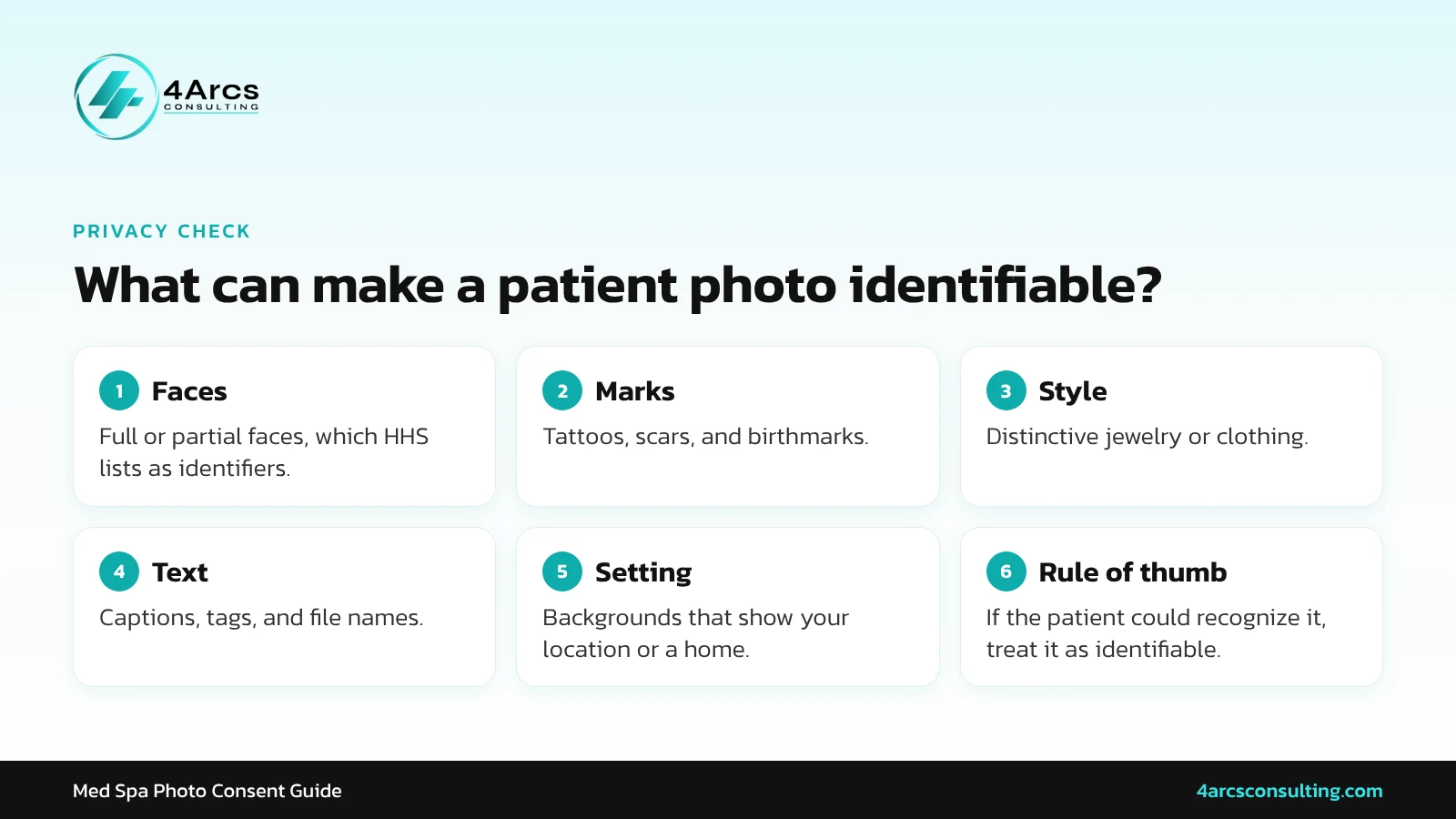
HHS lists “full-face photographs and any comparable images” among the identifiers that must be removed to de-identify health information. A photo can also point to a person through tattoos, distinctive marks, jewelry, a recognizable background, a caption, or a file name. Cropping out the face helps, but it does not guarantee anonymity.
HHS publishes the full list in its de-identification guidance (content last reviewed February 3, 2025). Treat any photo a patient could recognize as identifiable, and get consent that says so.
- Faces, including partial faces
- Tattoos, scars, and birthmarks
- Distinctive jewelry or clothing
- Captions, tags, and file names
- Backgrounds that show your location or a patient’s home
What Should a Med Spa Before-and-After Photo Consent Form Include?
A good form names the photos, the uses, the places, the time period, and the right to withdraw, in plain language the patient can read before signing. Avoid bundling photo consent into a long intake packet. A separate, signed page shows the patient made a clear choice.
| Element | What the form should say |
|---|---|
| Content | Photos, video, or both, and which treatments |
| Identifiability | Whether the face or other features will be visible |
| Uses | Website, social media, ads, email, or in the med spa only |
| Time period | How long you may use the images |
| Withdrawal | The patient may withdraw in writing, and how you will respond |
| Payment | Whether the patient receives anything in return |
| Signature | Patient name, signature, and date |
Have your attorney review the final wording. Requirements can differ by state and by whether your med spa is a covered entity.
Can You Post This Photo? A Decision List
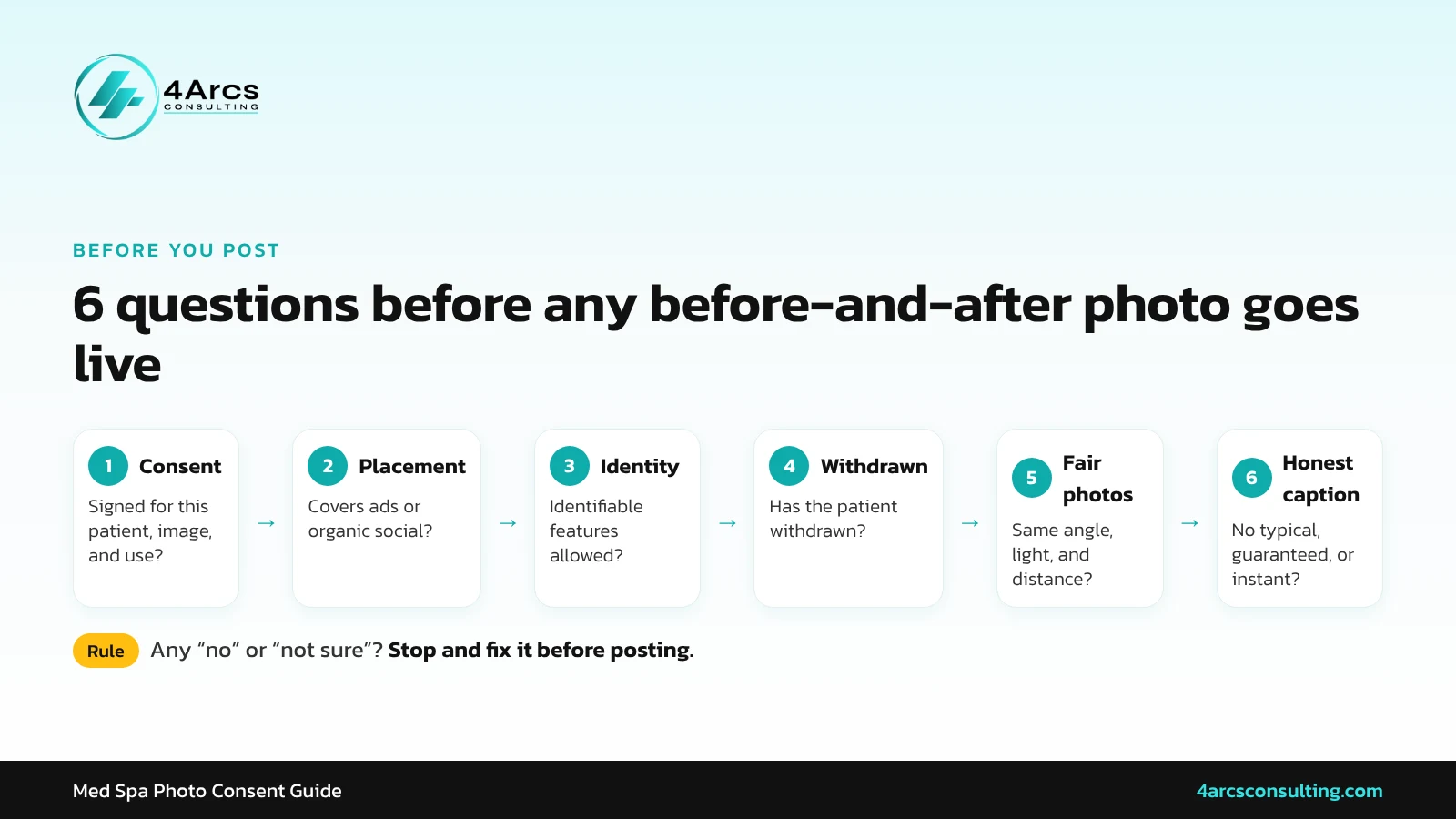
Run every image through the same questions before it goes live. If any answer is “no” or “not sure”, stop and fix it first. A written checklist keeps different staff members from making different calls on the same kind of image, and it gives you a record if anyone asks later.
- Do you have signed consent for this patient, this image, and this use?
- Does the consent cover the place you will post it, such as ads or organic social media?
- Is anything identifying visible, and does the consent say identifiable photos are allowed?
- Has the patient withdrawn permission since signing?
- Are the before and after photos taken with the same angle, lighting, and distance?
- Does the caption avoid implying that the result is typical, guaranteed, or instant?
Building a gallery page? Our med spa website design service covers before-and-after galleries and consultation request forms. For the rest of the site, see our med spa website best practices checklist.
How Do You Present Results Honestly?
Show results the way they happened. Use the same angle, lighting, and distance for both photos, skip filters and retouching, state how long after treatment the photo was taken, and never imply a result is typical when it is not. The FTC says advertising must be truthful and not misleading, and that claims need evidence behind them.
The FTC’s advertising and marketing guidance is the place to start. Avoid words such as “guaranteed” and “permanent” next to any photo. Ask your medical director to approve the claims in every caption.
What Do the Ad Platforms Say About Before-and-After Images?
Each platform sets its own rules, and they change. TikTok’s ad policy now allows cosmetic procedure ads in the United States and Canada with approval, and says before-and-after imagery must not exaggerate results. For other platforms, read the current policy yourself before you promote a photo.
| Platform | What we could verify |
|---|---|
| TikTok Ads (US and Canada) | Cosmetic procedure ads may be allowed with TikTok’s approval. Ads need age targeting, risk and recovery disclosure, and no exaggerated before-and-after imagery |
| Meta | We could not verify the current policy text. Read Meta’s Health and Wellness ad standard before you run ads |
| Google Business Profile | Google’s content policy does not allow deceptive or misleading health or medical information |
The source for the TikTok row is TikTok’s cosmetic surgery ad update, last updated April. Organic posts follow separate community rules, so check those too.
How Do You Store Consent and Handle Withdrawals?
Keep every signed form where you can find it quickly, and keep a log that links each image to its consent. When a patient withdraws, remove the image from every place you control, stop using it, and record the date. You cannot recall copies others already saved, so tell patients that when they sign.
| Log column | What to record |
|---|---|
| Patient record ID | An internal ID, not the patient’s name |
| Date signed | When consent was given |
| Treatments | Which treatments the photos show |
| Approved uses | Website, social media, ads, email |
| Expiry | When consent ends, if the form sets a period |
| Withdrawn | Date, if the patient withdrew |
| Posted where | Every location where the image appears |
What Should Staff Check Before Posting?
Give staff a short routine. They should confirm the consent, check the image for identifying details, use only business-owned devices and accounts, and get approval from one designated person before anything goes live. Personal phones and private messages are where most mistakes start.
- Find the signed form and match it to the image.
- Check the image for identifying details.
- Confirm the consent covers this place and use.
- Use a business-owned account and device.
- Get approval from the designated reviewer.
- Update the consent log.
Conclusion
Med spa before-and-after photo consent comes down to a few habits. Get written, specific consent before posting any patient photo, treat any recognizable image as identifiable, and show results honestly. Keep a consent log, handle withdrawals quickly, and have an attorney review your form because the rules depend on your status and state. This guide is general information, not legal advice. To turn honest results into a gallery that ranks and earns consultations, explore our med spa SEO services or request a free audit.
Want a Second Opinion on How Your Gallery Looks to Patients?
FAQs
Ans. Only if the manufacturer’s terms allow it, and you must label them as manufacturer images. Never present them as your own patients.
Ans. Yes, and often more care, because voices and faces identify people. Name video in the consent form.
Ans. Choose a stated period in the form and ask your attorney what suits your med spa. Renew consent when the period ends.
Ans. Treat it as a separate use and get permission for both. A patient agreeing to a review does not mean they agreed to a photo.
Ans. Avoid it. Use business-owned devices and accounts so that images stay under your control and your log stays accurate.
Ans. They may, and they vary. Ask a qualified attorney in your state to review your form.




What do you think?
[…] patients come back and recommend you, which is where med spa email marketing and a steady flow of med spa online reviews […]
[…] reading: see how to earn and reply to med spa online reviews and how med spa email marketing keeps patients coming […]
[…] Related reading: the post-appointment email is also the best moment to ask for feedback, so see our guide to med spa online reviews. […]
[…] guide to med spa online reviews covers how to earn and display […]