
Quick Answer: A good med spa SEO proposal names every deliverable, how many of each you get per month, how the agency reports results, who owns your accounts, and how you can exit. Compare proposals by scope, not price. For current price ranges, see our separate guide on how much med spa SEO costs.
Key Takeaways
- Every deliverable should have a name and a monthly quantity.
- Compare proposals on equal scope before comparing price.
- Reports should show consultations and calls, not just rankings.
- You should own your website, profile, analytics, and ad accounts.
- 4Arcs Consulting helps med spas with local SEO, website design, and social media marketing.
What Should a Med Spa SEO Proposal Include?
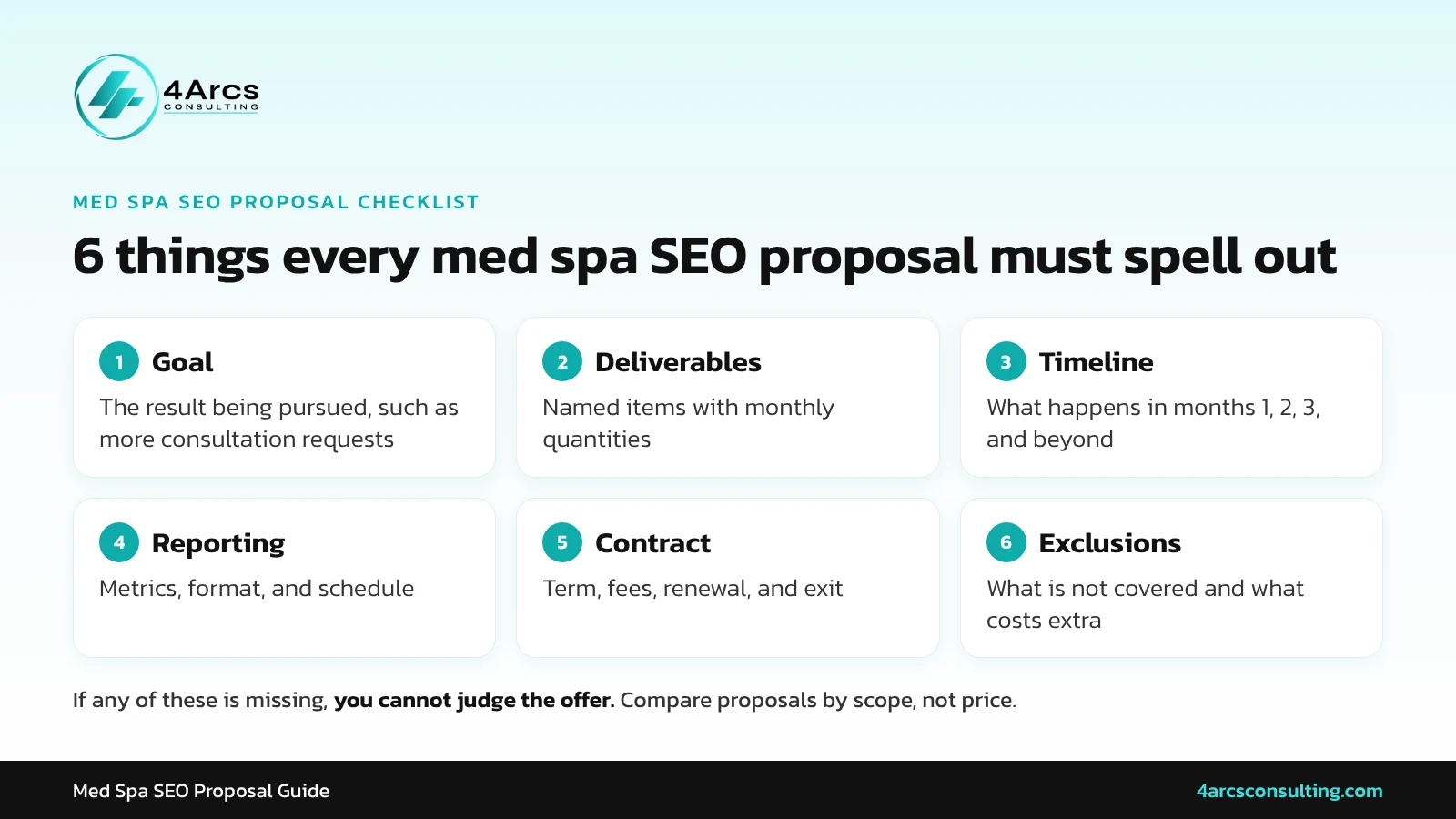
A proposal should state the goal, the deliverables with monthly quantities, the timeline, the reporting format, the contract terms, and what it leaves out. If any of these is missing, you cannot judge the offer or hold anyone to it later. Before you compare prices, ask the agency to fill any gaps in writing.
| Proposal element | What it should say |
|---|---|
| Goal | The result you want, such as more consultation requests |
| Deliverables | Named items with monthly quantities |
| Timeline | What happens in months one, two, three, and beyond |
| Reporting | Metrics, format, and schedule |
| Contract | Term, fees, renewal, and exit |
| Exclusions | What is not covered and what costs extra |
How Do You Read the Scope Line by Line?
Read each line and ask whether you could check it later. For example, you cannot check “SEO services,” but you can check “four new treatment pages a quarter, reviewed by your provider.” Vague wording hides gaps, and vague scope is the most common reason clients feel they received less than they expected.
| Vague line | Specific version to ask for |
|---|---|
| Content creation | Two new or refreshed pages per month, provider-reviewed |
| Local SEO | Profile setup, categories, services, photos, and local listings |
| Technical SEO | Speed, mobile, crawl errors, and structured data fixes in month one |
| Reporting | Monthly report with calls, forms, and booked consultations |
| Link building | A stated method and number of local mentions, with examples |
What Does Each Phase of Work Look Like?
Good proposals describe work in phases so you can see progress. Month one usually covers an audit, tracking, and profile fixes. Months two and three add core treatment pages and local listings. Later months expand content and reviews. If a proposal shows no sequence, ask what happens first and why.
| Phase | Typical work |
|---|---|
| Month 1 | Audit, analytics and call tracking, Google profile cleanup, technical fixes |
| Months 2 to 3 | Core treatment pages, local listings, review process |
| Months 4 to 6 | More treatment and comparison pages, local mentions, updates |
| Ongoing | Reporting, refreshes, new patient questions, review replies |
What Should the Monthly Report Show?
A report should connect work to outcomes: calls, form submissions, and booked consultations from search, plus the pages and searches that produced them. Rankings and traffic are useful context, but they are not results. Ask for a sample report before you sign and check that it matches how you measure success.
| Report item | Why it matters |
|---|---|
| Consultation requests from search | Shows real outcomes |
| Calls from search and your profile | Many patients phone first |
| Top pages and searches | Shows what is working |
| Work completed this month | Lets you verify deliverables |
| Plan for next month | Shows direction |
How Do You Verify the Work Was Done?
Spot-check deliverables each month instead of trusting the summary. For example, open the published pages, compare your Google profile to the last report, and confirm that tracking numbers and forms are recording. A short monthly check takes minutes and protects you from paying for work that never happened.
- Open each page listed as published and read it.
- Confirm that your provider actually reviewed the medical content.
- Review your Google profile for the changes reported.
- Submit a test form and place a test call.
- Compare the report with your own call and booking records.
Who Should Own the Accounts?
You should. Your domain, website, hosting, analytics, search console, Google profile, and ad accounts should be in your name, and you should add the agency as a user. If the agency owns them, you may lose history and access when the relationship ends. Put ownership in the proposal, not in a verbal promise.
What Should the Contract Say?
The contract should cover the term, the fee, what changes the fee, how either side ends the agreement, and what you receive on exit. Prefer a defined review point after a few months over a long lock-in. A clear contract protects both sides and prevents disagreements over what each side promised.
- Term length and renewal terms
- A review point after the first few months
- Fees, and what triggers extra charges
- Exit terms, with notice period
- Transfer of accounts and files on exit
Which Costs Sit Outside the Proposal?
First, ask what the agency bills separately. Common extras include ad spend, website rebuilds, extra copywriting, photography and video, software, and fees to access your own accounts if you leave. Request a written list of exclusions so the total first-year cost is clear before you commit.
- Ad spend (always separate from SEO)
- Website development or rebuild work
- Copywriting beyond a set number of pages
- Photography, video, and design
- Software subscriptions
- Account transfer fees
How Do You Compare Three Proposals Fairly?
List every deliverable from each proposal in one table and mark each item as included, excluded, or unclear. Then compare reporting, contract terms, and account ownership. Proposals become comparable only when they cover the same scope, so ask each agency to fill gaps before you decide.
| Question | Agency A | Agency B | Agency C |
|---|---|---|---|
| Treatment pages included? | |||
| Profile and local work included? | |||
| Content pieces per month? | |||
| Reports show consultations? | |||
| Contract term and exit? | |||
| You own the accounts? |
Fill in each cell with Yes, No, or Unclear. Every “Unclear” is a question to send back to that agency, and once all three columns are complete, the cheapest proposal is often not the best value.
What Red Flags Appear in a Med Spa SEO Proposal?
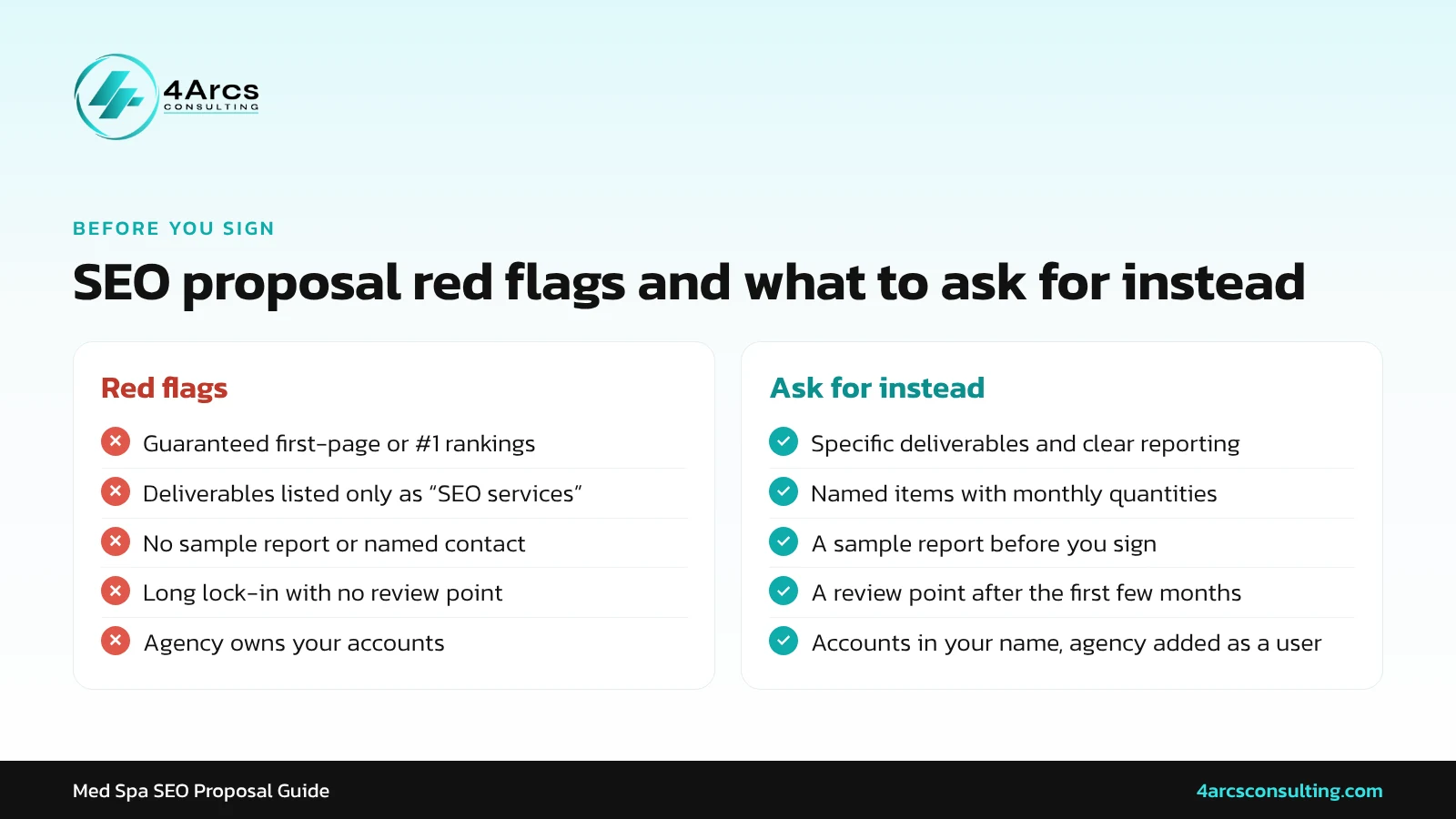
The main red flags are guaranteed rankings, undefined deliverables, no sample report, pressure to sign quickly, and unclear ownership. No agency controls Google, so none can promise a position. A proposal that refuses to name deliverables is asking you to trust rather than verify.
- Guaranteed first-page or first-position rankings
- Deliverables described only as “SEO services”
- No sample report or no named contact
- Long lock-in with no review point
- Refusal to put account ownership in writing
What Should a Med Spa Ask About Compliance?
Ask how the agency handles patient information in forms and tracking, who reviews medical content, and how patients authorize before-and-after images. Health-related tracking and images carry privacy obligations. See HHS guidance on HIPAA and marketing. This is general information, not legal advice.
When Is SEO Not the Right First Move?
SEO is the wrong first move when the basics are missing or when you need patients within weeks. A med spa with no tracking cannot tell whether SEO works. A med spa with no capacity for new patients gains little from more inquiries. Fix those gaps, or start with ads, first.
- No tracking: set up call and form tracking before spending.
- No capacity: extra inquiries go to waste if you cannot book them.
- A launch in weeks: ads reach patients faster than SEO can.
- No clear offer: pages cannot convert a treatment you have not defined.
What Results Have Med Spas Seen From SEO?
Results vary by med spa, and the examples here come from our own case studies, which do not state timeframes. rADiant Wellness & Aesthetics in Linden, Tennessee, reports a #1 Google ranking for its services in Linden and a 164% increase in organic search traffic after a website redesign and local SEO.
Piel Aesthetics Med Spa in Cedar Park, Texas, reports a 131% increase in organic leads. Open any client in the table below to read the full story, or browse all success stories. These are self-reported results and are not guarantees.
Across five med spa SEO case studies published on our site, reported organic traffic gains ranged from 127% to 236%. Each figure below comes from that client’s case study page.
| Med spa | Reported organic result |
|---|---|
| Intentional Wellness Medspa | 127% increase in organic website traffic |
| Absolute Aesthetics | 131% increase in organic traffic |
| NTRL + NAKD Skin Spa | 132% increase in organic traffic |
| rADiant Wellness & Aesthetics | 164% increase in organic search traffic |
| Piel Aesthetics Med Spa | 236% increase in organic sessions |
All results are self-reported, vary by med spa, and are not guaranteed.





What Questions Should You Ask Before You Sign?
Ask what you receive each month, which pages come first, how the agency handles patient data in tracking, how it reports results, who owns your accounts, and how to exit. A confident agency answers in plain language and in writing. Compare answers across agencies, not just proposals.
On its med spa SEO page, 4Arcs Consulting lists local search optimization, Google Business Profile optimization, monthly ranking reports, technical SEO fixes, local citation building, and competitor analysis among its inclusions. At 4Arcs, we start with a free audit that checks current treatment rankings and identifies quick wins, then build a plan around your med spa and local market.
Related reading: see how to earn and reply to med spa online reviews and how med spa email marketing keeps patients coming back.
Conclusion
Read a med spa SEO proposal line by line, and sign only when deliverables, reporting, ownership, and exit terms appear in writing. Compare proposals on equal scope, spot-check the work each month, and judge results by consultations rather than rankings. 4Arcs Consulting offers a free audit as a no-pressure starting point, so request your free audit.
Want a Second Opinion on Your SEO Proposal?
FAQs
Ans. You can ask, but many agencies prefer a short initial term with a review point. That gives both sides time to show results without a long commitment.
Ans. Each location needs its own page, profile, and reviews, so the proposal should list them separately. However, the agency can price shared work, such as technical fixes, once.
Ans. A writer drafts them and your provider reviews them for accuracy. Ask who does each step and how long review takes.
Ans. Not always. If the site is slow or hard to use on phones, fix that first. The audit should tell you which.
Ans. Both sides should agree to changes in writing, with the reason and any effect on fees. Before you sign, ask how the agency handles scope changes.
Ans. No. Google controls rankings, so no agency can promise a position. Look for specific deliverables and clear reporting instead.




What do you think?
[…] weighing whether your website itself is holding you back, our related guide on why every small business needs a high-performing website breaks that down […]
[…] For why the website comes first, see why every small business needs a high-performing website. […]
[…] A strong site also lifts returns; see why every small business needs a high-performing website. […]
Comments are closed.