
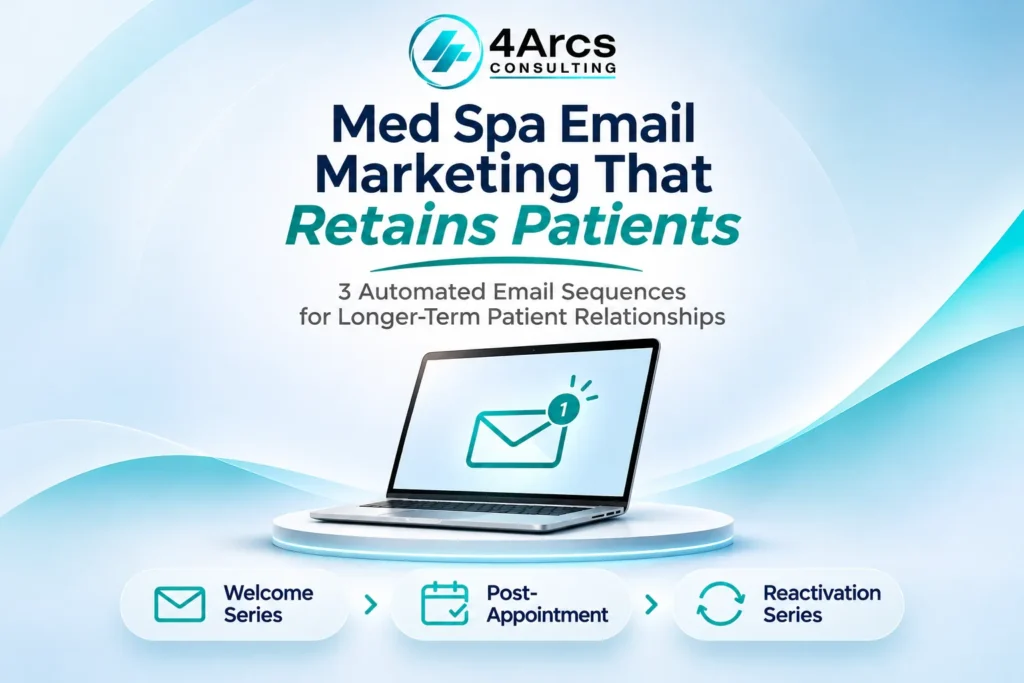
Quick Answer: Med spa email marketing works best as three automated sequences: a welcome series for new contacts, a post-appointment follow-up about 48 hours after treatment, and reactivation messages for patients who have not returned in 60, 120, and 180 days. Collect clear opt-in consent, follow CAN-SPAM, and keep treatment details out of message content.
Key Takeaways
- Build three sequences once: welcome, post-appointment, and reactivation.
- Send the post-appointment email about 48 hours after treatment.
- Reactivate quiet patients at roughly 60, 120, and 180 days.
- Time rebooking reminders to how long each treatment’s results last.
- Win back patients who ignore check-ins with a new offer or treatment.
- Keep treatment and condition details out of subject lines and previews.
- 4Arcs Consulting helps med spas bring in new patients through SEO and social media that email can then retain.
In This Guide
- Why Does Med Spa Email Marketing Retain Patients?
- What Three Sequences Does a Med Spa Need?
- What Should the Welcome Series Say?
- What Should the Post-Appointment Email Say?
- What Should Reactivation Emails Say?
- When Should You Send Rebooking Reminders?
- What Other Emails Should a Med Spa Send?
- What Does a Complete Med Spa Email Look Like?
- How Do You Build a Permission-Based List?
- Which Compliance Rules Apply?
- How Do You Get Emails Into the Inbox?
- How Should You Segment Your List?
- How Do You Choose an Email Platform?
- Should You Add Text Messages?
- How Do You Measure Email Performance?
- Conclusion
- FAQs
Why Does Med Spa Email Marketing Retain Patients?
Most lapsed patients are not unhappy; they simply hear nothing. Email lets you reach patients you already earned, at low cost, without depending on a social platform’s algorithm. It is also the one channel you own, so a platform change cannot take your list away.
Many aesthetic treatments are repeat services, so patient value sits in the return visit.
What Three Sequences Does a Med Spa Need?
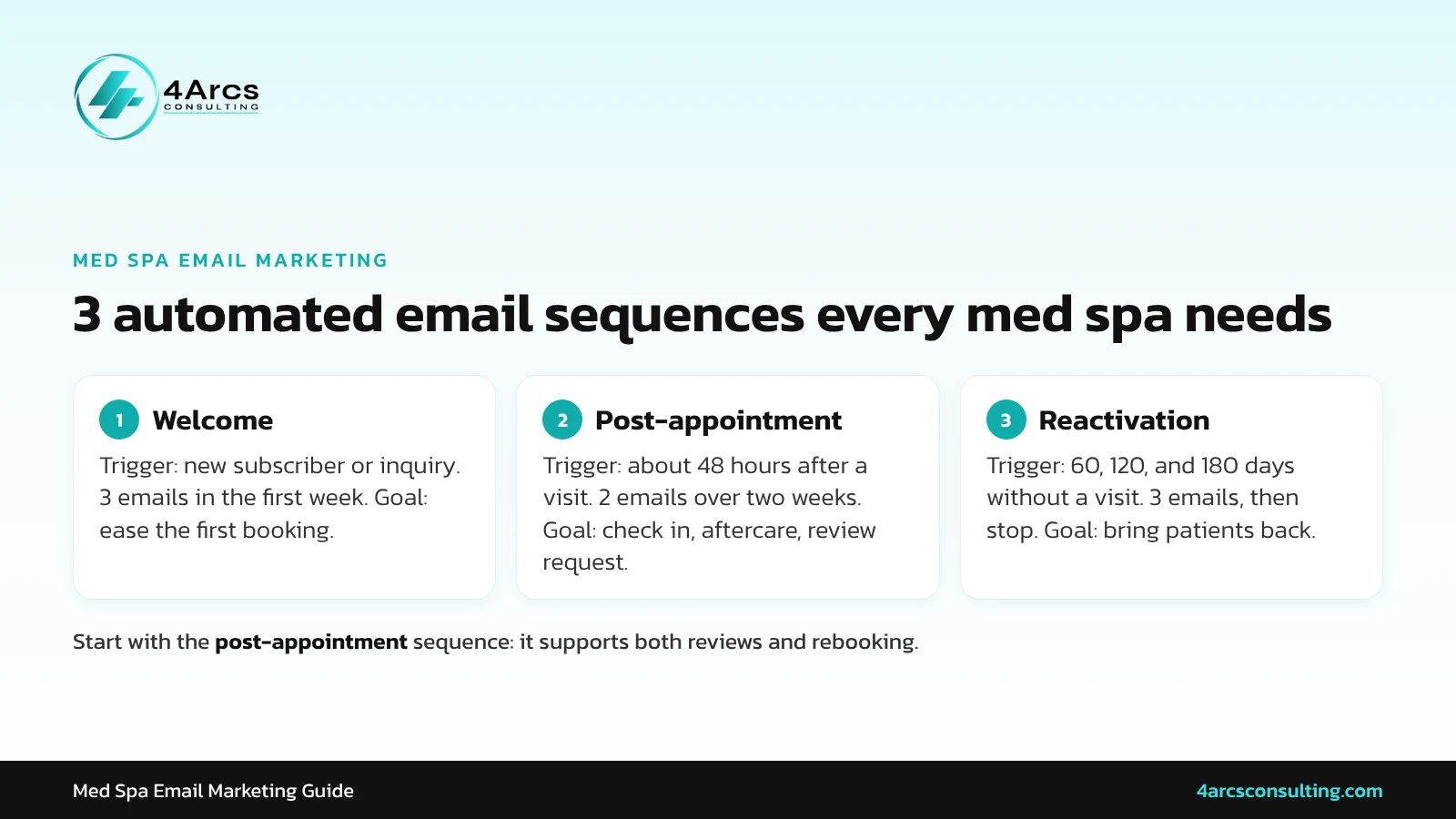
A med spa needs a welcome series, a post-appointment sequence, and a reactivation series. Each has a trigger, a goal, and a small number of emails, and each runs automatically once built. Start with the post-appointment sequence because it supports reviews and rebooking.
| Sequence | Trigger | Goal | Emails |
|---|---|---|---|
| Welcome | New subscriber or inquiry | Ease the first booking | 3 in the first week |
| Post-appointment | About 48 hours after a visit | Check in, aftercare, review request | 2 over two weeks |
| Reactivation | 60, 120, 180 days without a visit | Bring patients back | 3, then stop |
What Should the Welcome Series Say?
Introduce the med spa and providers, explain how a first consultation works, and answer common concerns. Day 0 sets expectations, day 2 walks through the consultation, and day 5 answers the biggest worries with a booking button. Keep each email short and focused on one idea.
| Day | Purpose | Example subject |
|---|---|---|
| 0 | Welcome and set expectations | “Welcome, here is what happens next” |
| 2 | Walk through the consultation | “What to expect at your first visit” |
| 5 | Answer common worries, invite booking | “Questions people ask before booking” |
What Should the Post-Appointment Email Say?
Thank the patient, point back to the aftercare instructions they received in person, invite questions, and ask for a review. Keep it general and leave the treatment name out of the subject line and preview text, so the message works for every patient and protects privacy.
Sample subject: “A quick check-in after your visit”
The second email, about two weeks later, can suggest a follow-up visit when appropriate. Your clinical team should decide what timing is right for each treatment.
What Should Reactivation Emails Say?
Lead with help, not a discount. A seasonal skin-care tip or an invitation to talk through goals usually works better than a coupon. Space messages at 60, 120, and 180 days, and stop after the last one if there is no response. Emailing unresponsive contacts harms deliverability.
Sample reactivation message: “It has been a while since your last visit. Here is a quick seasonal skin-care tip, and if you would like to talk through your goals, you can book a time here: [link].”
| Message | Timing | Purpose |
|---|---|---|
| 1 | About 60 days after last visit | Friendly check-in |
| 2 | About 120 days | Useful seasonal education |
| 3 | About 180 days | Invitation to discuss goals, then stop |
How Can New Offers Bring Lapsed Patients Back?
Some patients will not respond to check-ins alone. For them, a fresh reason to return often works better: a new treatment, a seasonal package, or an offer made just for past patients. At 4Arcs Consulting, we run reactivation campaigns for med spas that pair new offers with each patient’s past treatment interest to bring former patients back.
- Announce something new, such as a new treatment, device, or provider.
- Offer a returning-patient package or seasonal special with a clear end date.
- Match the offer to each patient’s past treatment interest, without naming treatments in the subject line.
- Send only to past patients who opted in to marketing, and stop for anyone who does not engage.
- Check that offers and pricing follow your state’s advertising rules.
Sample subject: “Something new for returning patients”
When Should You Send Rebooking Reminders?
Rebooking reminders are timed to how long results usually last, so patients hear from you just before they would notice a change. According to the American Society of Plastic Surgeons, botulinum toxin results typically last about three to four months, while dermal filler results last from several months to several years depending on the filler used. Your clinical team should set the exact timing for each treatment.
| Treatment | Typical result length | Suggested reminder |
|---|---|---|
| Neurotoxin (botulinum toxin) | About three to four months | Around 10 to 12 weeks after the visit |
| Dermal fillers | Several months to several years, by product | As advised by your provider for the filler used |
| Treatment series | Set by the treatment plan | Before each planned session, then when the series ends |
Keep the treatment name out of the subject line. A message such as “Time to plan your next visit” works for every patient and protects privacy.
What Other Emails Should a Med Spa Send?
Beyond the three core sequences, a few occasional emails keep patients engaged without overwhelming them. Send each one only to patients who opted in to marketing.
- Birthday emails: a short personal note, with or without a small birthday offer.
- Membership emails: renewal reminders, monthly credits, and member-only events.
- Announcements: a new treatment, device, or provider.
- Event invitations: open houses, product launches, or educational evenings.
- Referral reminders: thank patients who refer friends and explain how your program works.
- A monthly or seasonal newsletter: a seasonal skin-care tip, news, and one clear booking link.
What Does a Complete Med Spa Email Look Like?
Every email needs a subject line, preview text, a short body, one button, and a footer with your physical address and an unsubscribe link. These three templates can be adapted to your med spa.
| Part | Welcome (day 0) | Post-appointment (about 48 hours) | Reactivation offer |
|---|---|---|---|
| Subject | “Welcome, here is what happens next” | “A quick check-in after your visit” | “Something new for returning patients” |
| Preview text | “Your first consultation, step by step” | “We are here if you have questions” | “A new option we think you will like” |
| Body | “Hi [First name], thank you for reaching out to [Med Spa Name]. Your first visit starts with a consultation, where a licensed provider listens to your goals and explains your options. There is no pressure to book a treatment that day.” | “Hi [First name], thank you for visiting us. If you have questions about your aftercare, reply to this email or call us at [phone]. If you have a minute, an honest review helps others choose with confidence.” | “Hi [First name], it has been a while since your last visit. We have added [new treatment or package], and as a returning patient you can [offer details] until [end date].” |
| Button | Book your consultation | Leave a review | Book a time |
How Do You Build a Permission-Based List?
Collect addresses with clear permission through sign-up forms, a tablet or QR code at checkout, event registrations, and useful guides. Ask for treatment interest and location so you can segment. Never buy a list, and remove bounced and invalid addresses regularly.
- Short forms on treatment pages
- A QR code at the front desk
- Event and webinar registrations
- A skin-care guide as an incentive
Which Compliance Rules Apply?
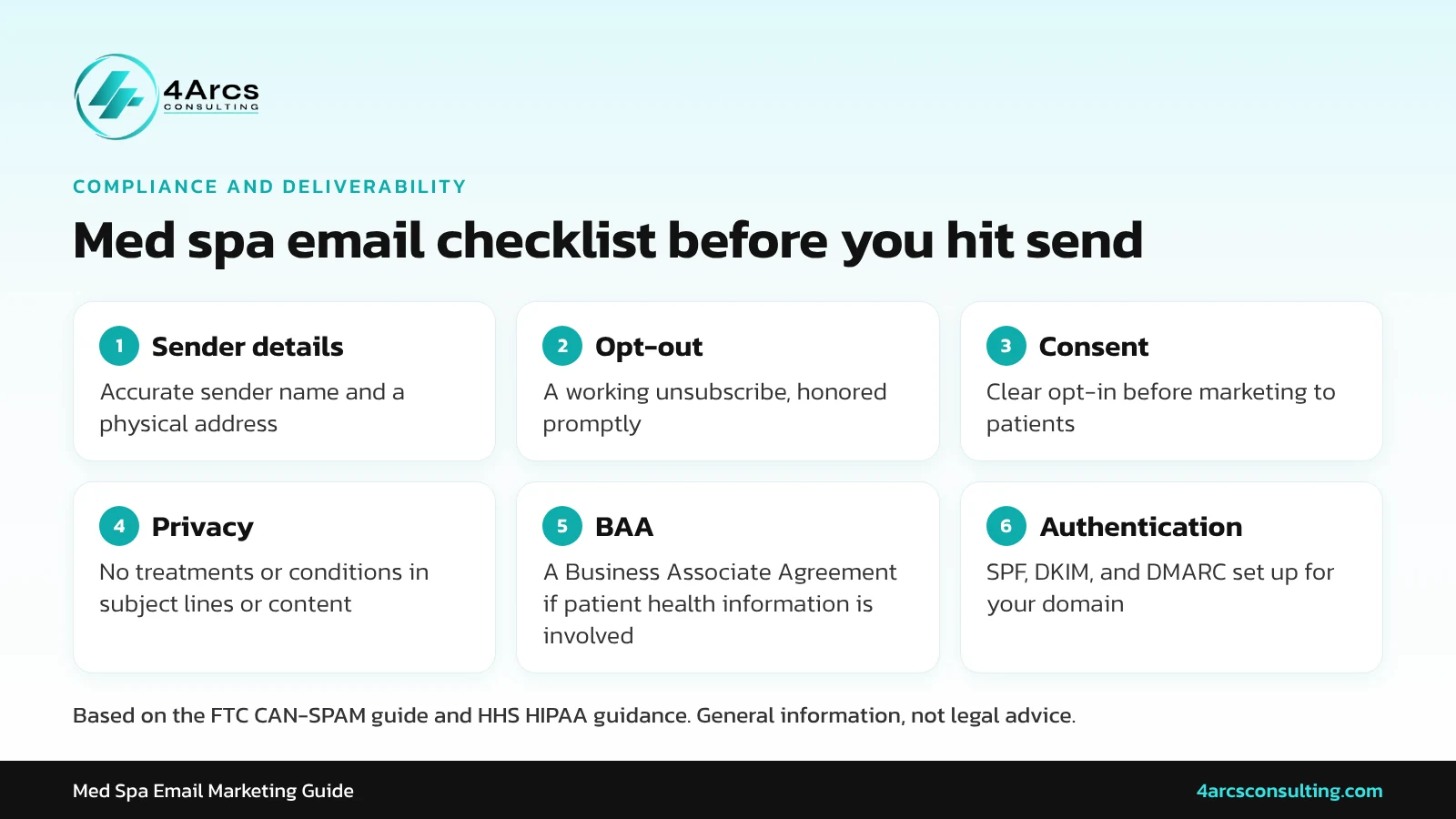
Three sets of rules apply to med spa email: CAN-SPAM, consent, and health-privacy rules. The FTC’s CAN-SPAM compliance guide requires accurate sender details, honest subject lines, a physical address, and a working opt-out. For patient information, see HHS guidance on HIPAA and marketing. HIPAA applies only if your med spa is a covered entity, which typically means it bills health insurance electronically, so check whether it applies to you and follow your state’s privacy laws either way.
- Include sender details and a physical address.
- Honor opt-out requests within 10 business days.
- Get clear opt-in before marketing to patients.
- Keep treatments and conditions out of message content.
- If HIPAA applies and patient health information is involved, confirm your email provider will sign a Business Associate Agreement.
Text messaging falls under the Telephone Consumer Protection Act (TCPA), which generally requires prior express written consent for marketing texts. See the FCC’s guide to unwanted robocalls and texts. This is general information, not legal advice.
How Do You Get Emails Into the Inbox?
Ask your email provider or web team to set up SPF, DKIM, and DMARC authentication for your sending domain. Send from a recognizable name, keep lists clean, remove bounces, and avoid large sends from a brand-new domain without warming it up gradually.
How Should You Segment Your List?
Segmenting means sending different messages to different groups. Even three segments usually work better than one blast: new inquiries, active patients, and lapsed patients. Add members as a fourth group if you run a membership. Each group needs different content and a different next step.
| Segment | Example message |
|---|---|
| New inquiry | Consultation walkthrough |
| Active patient | Seasonal care and events |
| Lapsed patient | Check-in and reactivation |
| Member | Member-only education |
How Do You Choose an Email Platform?
Choose a platform that connects to your booking software, so emails are triggered by real appointment data instead of manual lists. Booking platforms such as Boulevard, Zenoti, and Mangomint include marketing automation tools, while others, such as Aesthetic Record, connect to email platforms through integrations.
- Automation triggered by bookings, visits, and inactivity
- Segmentation by treatment interest, visit history, and membership
- Mobile-friendly templates that are easy to edit
- Reporting on clicks, bookings, and unsubscribes
- A signed Business Associate Agreement if HIPAA applies and patient health information is involved
Should You Add Text Messages?
Text messages suit short, time-sensitive messages such as appointment reminders and last-minute openings, while email suits longer content such as aftercare tips, newsletters, and offers. Many med spas use both. Marketing texts need prior express written consent under the TCPA, so collect text consent separately from email consent and include clear opt-out instructions, such as “Reply STOP to unsubscribe.”
How Do You Measure Email Performance?
Measure clicks, bookings, and unsubscribes, not just opens, because open rates are less reliable now that features such as Apple Mail Privacy Protection can register opens automatically. Track bookings from email, click rate by sequence, unsubscribe rate, and replies, then retire emails that never produce any action.
| Metric | What it tells you |
|---|---|
| Bookings from email | Revenue impact |
| Click rate by sequence | Which message works |
| Unsubscribe rate | Whether frequency is too high |
| Replies | Whether patients feel heard |
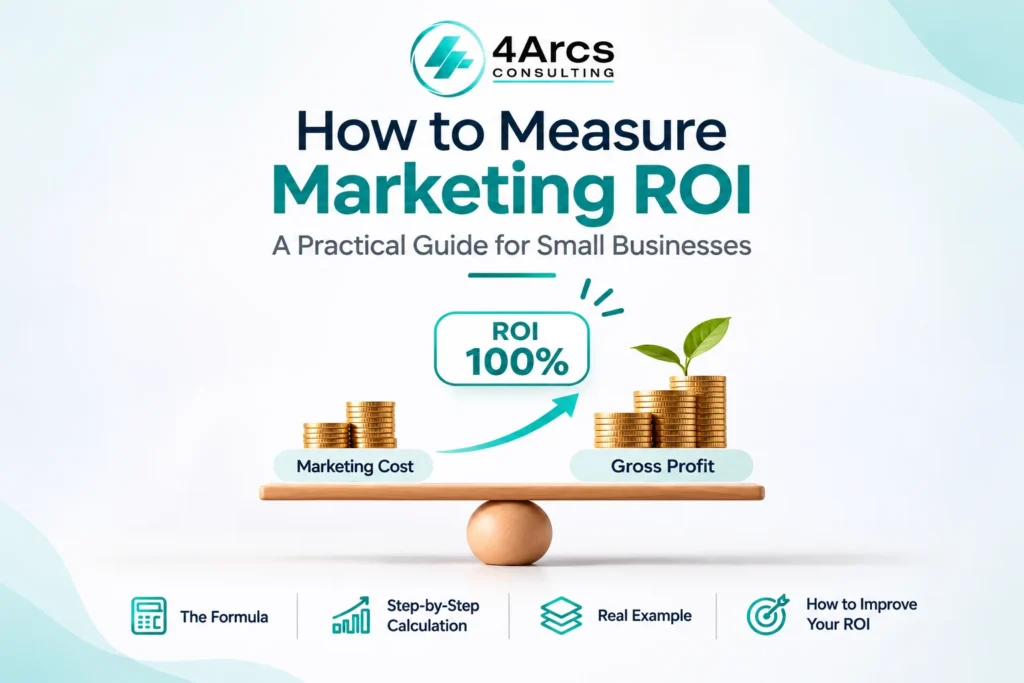
For context, Mailchimp’s email benchmark data (last updated December 2023) shows an average click rate of 2.62% and an unsubscribe rate of 0.22% across all of its users. Use these as rough reference points, then compare each sequence with its own past results. To connect email to revenue, see how to measure marketing ROI for a small business.
4Arcs Consulting helps med spas with SEO and social media marketing, so email has new patients to retain. At 4Arcs, we build the acquisition side with med spa SEO and med spa social media marketing.
For paid acquisition, read social media advertising for medical spas. Our Absolute Aesthetics case study reports a $4.91 cost per lead from Meta advertising, a self-reported result.
On the organic side, NTRL + NAKD Skin Spa reports 150% growth in online bookings after SEO work, also a self-reported result.
Related reading: the post-appointment email is also the best moment to ask for feedback, so see our guide to med spa online reviews.
Conclusion
Successful med spa email marketing comes down to a few steps: build three automated sequences, collect consent, keep treatment details out of messages, and measure bookings instead of opens. Start with the post-appointment email, then add welcome and reactivation, and time rebooking reminders to how long each treatment lasts. Email retains patients; it works best alongside search and social channels that bring new ones in. To strengthen that acquisition side, explore our med spa SEO service.
Ready to Bring More Patients Back?
FAQs
Ans. Use automated sequences plus an occasional value email. Consistency matters more than frequency.
Ans. Only those who opted in to marketing. Check your records before sending.
Ans. Choose one with automation, segmentation, and a willingness to sign a Business Associate Agreement where needed. Confirm this before you import patient data.
Ans. Occasionally. Helpful content builds more loyalty than constant discounts, so save offers for reactivation campaigns aimed at patients who have not returned.
Ans. Short enough to read on a phone in under a minute, with one main action. Long emails tend to bury the next step.
Ans. Do not answer health details by regular email. Invite them to call, or use a secure channel your med spa has approved.
Ans. Only if your med spa is a HIPAA covered entity, which typically means it bills health insurance electronically. Either way, keep treatments and conditions out of marketing emails and follow your state’s privacy laws.
Ans. Yes, but marketing texts need prior express written consent under the TCPA. Collect text consent separately from email consent and include clear opt-out instructions.
Ans. One or two useful seasonal tips, news about new treatments or providers, upcoming events, and one clear booking button. Keep it short enough to read on a phone.


What do you think?
[…] lifetime value grows when patients come back and recommend you, which is where med spa email marketing and a steady flow of med spa online reviews […]
Comments are closed.