Quick Answer: A social media plan for small business starts with choosing one or two platforms where your customers already look, posting useful content three or four times a week, and measuring messages, calls, and bookings instead of likes. Disclose any paid relationship with creators. The 90-day plan below takes you from setup to a tested routine.
Key Takeaways
- Choose one or two platforms, not all of them.
- Mix education, proof, people, and occasional offers.
- Measure messages, calls, and bookings, not followers.
- Disclose paid relationships with creators clearly.
- 4Arcs Consulting offers social media marketing and social media management for small businesses.
In This Guide
- What Is Social Media Marketing for a Small Business?
- Which Social Platforms Should a Small Business Start With?
- What Should a Small Business Post?
- How Much Time Should Social Media Take?
- What Weekly Workflow Saves Time?
- How Should You Respond to Comments and Messages?
- What Rules Apply to Creators and Customer Content?
- Should You Pay for Social Ads?
- What Does a Managed Month of Social Media Include?
- What Does the First 90 Days Look Like?
- How Do You Measure Social Media Success?
- What Do Real Results Look Like?
- Should You Do It Yourself or Get Help?
- Conclusion
What Is Social Media Marketing for a Small Business?
Social media marketing means using social platforms to build awareness, answer customer questions, and turn followers into inquiries. For a small business, the goal is not a big audience. It is a steady presence that makes customers trust you before they call, and that supports your website, search visibility, and email.
In fact, customers often check a profile to see whether a business is active, who is behind it, and what others say. A consistent profile builds familiarity before the first call.
Which Social Platforms Should a Small Business Start With?
Choose platforms based on where your customers already spend time and what you can sustain. Local service businesses often start with Facebook and Instagram, visual product businesses with Instagram and Pinterest, and business-to-business firms with LinkedIn. However, these are common starting points, not rules, so ask five recent customers where they look for businesses like yours.
| Business type | Common starting point |
|---|---|
| Local service | Facebook, Instagram |
| Visual products | Instagram, Pinterest |
| Business-to-business | |
| Lifestyle or entertainment | Short-video platforms |
What Should a Small Business Post?
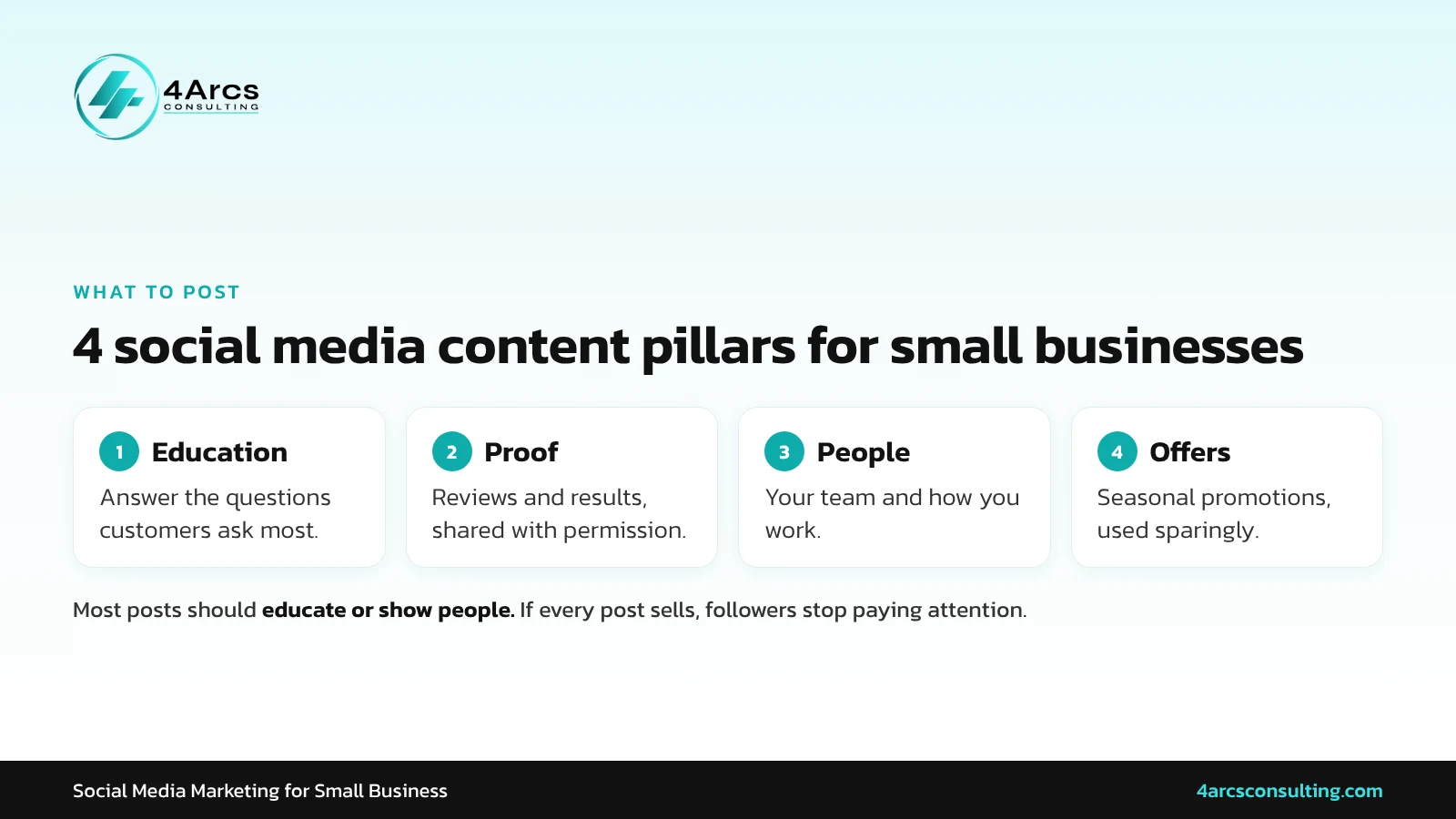
Mix four content pillars: education that answers common questions, proof such as reviews and results shared with permission, people and process content, and occasional offers. Most posts should educate or show people, because if every post sells, followers stop paying attention. Keep the mix steady from week to week.
- Education: answer the questions customers ask most.
- Proof: reviews and results, with permission.
- People: your team and how you work.
- Offers: seasonal promotions, used sparingly.
How Much Time Should Social Media Take?
Plan for two to five hours a week for a steady routine, and choose a level you can sustain. Above all, consistency matters more than volume. If you cannot keep up, drop to a lower level instead of posting in bursts and then disappearing for a month. These levels are our planning estimates, not platform benchmarks.
| Level | Time per week | Output |
|---|---|---|
| Minimum | 2 hours | 2 posts, reply to comments |
| Steady | 4 to 5 hours | 3 to 4 posts, 1 short video, daily replies |
| Growth | 8+ hours or outsourced | Daily posts, ads, community management |
What Weekly Workflow Saves Time?
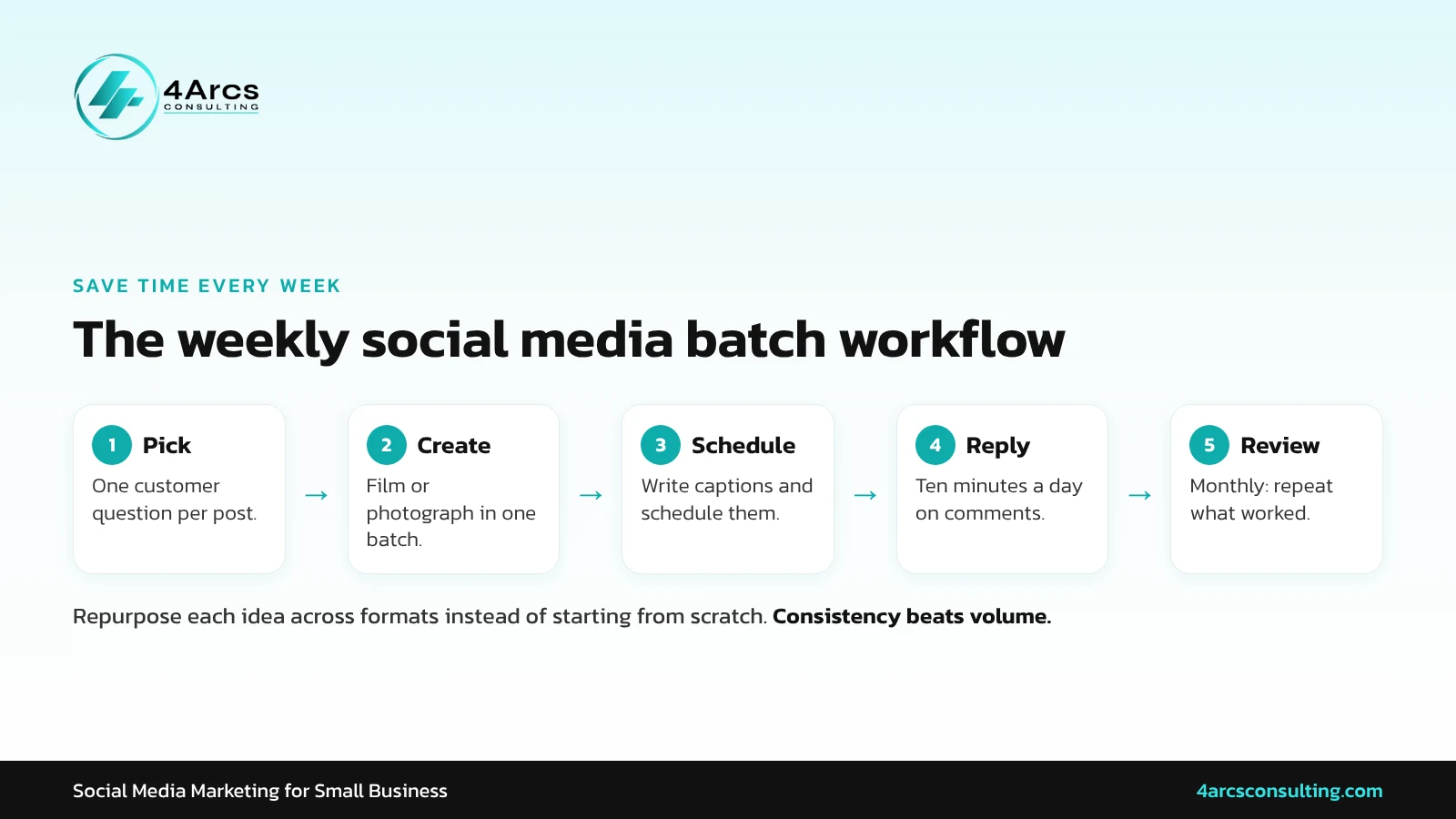
A weekly batch workflow saves the most time. Pick one customer question per post, create everything in one session, schedule posts in advance, reply to comments and messages daily, and review results monthly. Also, repurpose each idea across formats instead of starting from scratch every time.
- Pick one customer question per post.
- Film or photograph in one batch.
- Write captions and schedule them.
- Reply to comments daily for ten minutes.
- Review monthly and repeat what worked.
Short on time? See how social media management can take daily posting off your plate.
How Should You Respond to Comments and Messages?
Reply promptly, warmly, and publicly to general questions, and move detailed or sensitive discussions to private messages or a phone call. A fast answer often turns a follower into a customer. On the other hand, treat negative comments calmly: reply briefly, offer to continue privately, and avoid arguing in public.
What Rules Apply to Creators and Customer Content?
If you pay or gift a creator, the relationship must be disclosed clearly. The FTC explains this in its Endorsement Guides FAQs and in Disclosures 101 for Social Media Influencers. Disclosures should be easy to notice, not buried in a pile of hashtags, and creators should describe only real experiences.
Similarly, never post a customer’s photo or words without permission, and keep a record of that permission. Put these rules in writing in any creator agreement, and review posts before they go live.
Should You Pay for Social Ads?
Paid ads amplify what already works. For that reason, post organically first, see which posts earn saves, shares, and messages, then put a small budget behind the best ones with a tight local audience. Our social media marketing services page says most local businesses see good results starting with $500 to $1,500 a month in ad spend, plus management.
For med spas, our article on social media advertising for medical spas covers the paid side in detail.
What Does a Managed Month of Social Media Include?
A managed month covers the daily work that most often slips when owners get busy: creating content, posting, replying to comments, watching messages, and reporting. For this reason, deciding in advance who does each task, and how long it takes, keeps the routine alive whether you handle it yourself or hire help.
Our social media management page lists daily management, content creation, photo and video editing, community engagement, message monitoring, a content calendar, and monthly performance reports for Facebook, Instagram, and TikTok. Clients supply raw photos and videos.
What Does the First 90 Days Look Like?
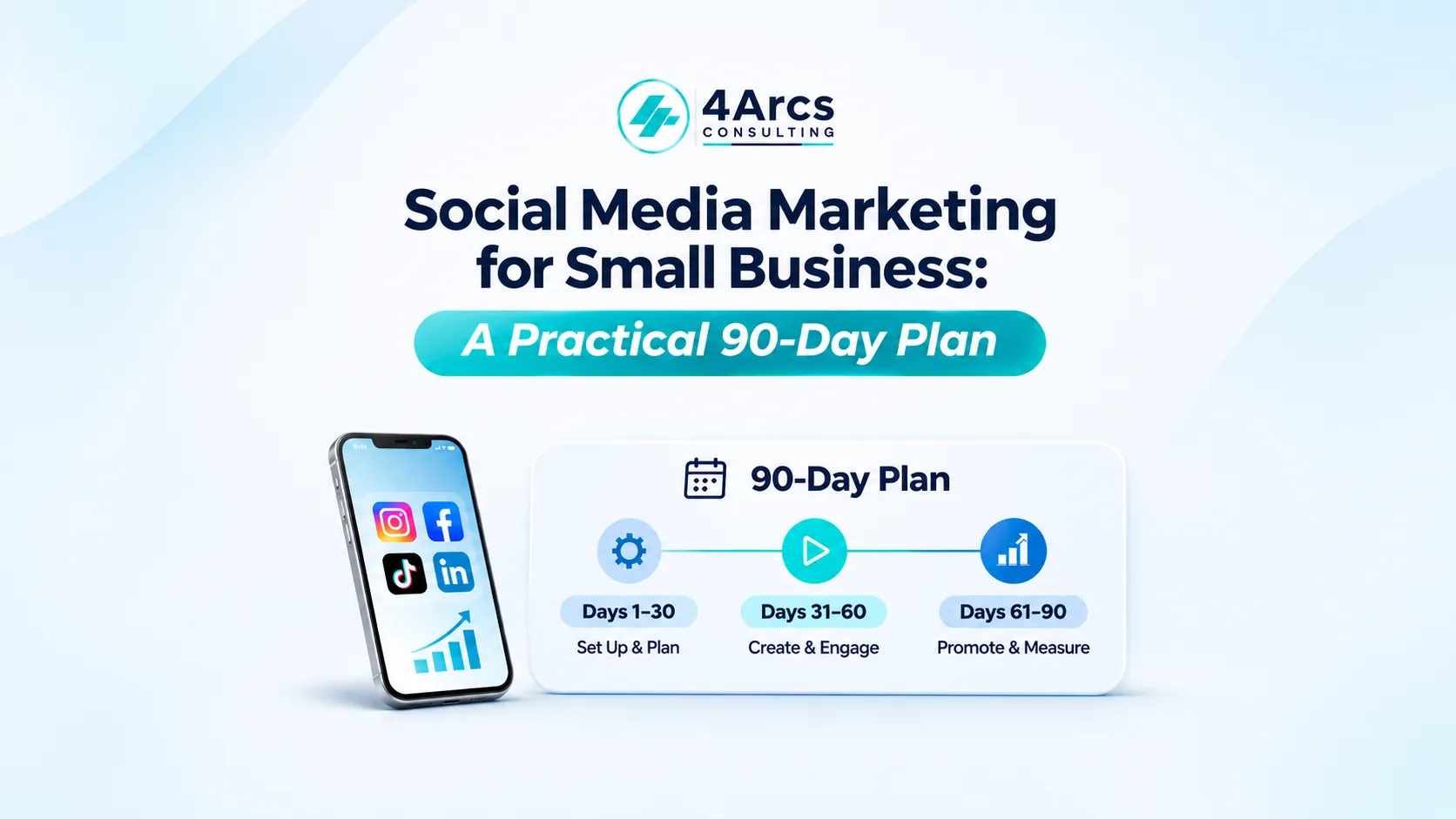
The first 90 days should move from setup to learning to scaling. Month one builds profiles, a content calendar, and tracking. Month two keeps posting steady and notes which posts earn messages. Finally, month three puts a small budget behind the best posts and decides what to keep. Throughout, judge progress by inquiries, not followers.
| Period | Focus |
|---|---|
| Month 1 | Complete profiles, set up tracking, plan four weeks of posts |
| Month 2 | Post on schedule, reply daily, note which posts earn messages |
| Month 3 | Boost the best posts to a local audience, review cost per lead |
How Do You Measure Social Media Success?
Measure what leads to business: messages, calls, link clicks, bookings, and cost per lead for paid posts. After all, followers measure reach, not revenue. Ask new customers how they found you, because social influence often shows up later as a search for your business name.
| Metric | What it tells you |
|---|---|
| Messages and calls | Direct interest |
| Link clicks | Content relevance |
| Bookings or sales | Real outcome |
| Saves and shares | Usefulness |
| Cost per lead (paid) | Efficiency of ad spend |
What Do Real Results Look Like?
Results depend on the business, and these examples are self-reported from our case studies, which do not state timeframes. Neither is a promise of what your business will see. Collagen Bar NYC reports 900+ leads at a $2 cost per lead from paid social and custom landing pages.
Absolute Aesthetics reports a $4.91 cost per lead and a 132% increase in qualified leads through Meta advertising (published May 7, 2025). Results are not guarantees and vary by market.

Should You Do It Yourself or Get Help?
Do it yourself if you have the time and enjoy it, and get help when consistency slips. Two levels of help exist: strategy and content creation, and day-to-day posting and engagement. 4Arcs Consulting offers both through its social media marketing and social media management services.
Conclusion
Choose one or two platforms, post useful content on a steady schedule, answer messages quickly, and measure leads rather than likes. Disclose paid relationships and use customer content only with permission. Social media strengthens search, email, and your website, but it does not replace them. 4Arcs Consulting can help with strategy or daily posting, so explore our social media marketing service.
Want Help Building Your Social Media Plan?
FAQs
Ans. It varies by business and market. Consistent posting for a few months is a fair test.
Ans. Use a few relevant ones. Clear content and captions matter more.
Ans. No. It violates platform rules and gives you an audience that never buys.
Ans. Review customer questions, reviews, and common sales questions. Each one is a potential post.
Ans. A simple one prevents gaps. A shared spreadsheet is enough.
Ans. Reuse the idea, but adjust the format and length for each platform. Copying a post unchanged often looks out of place.