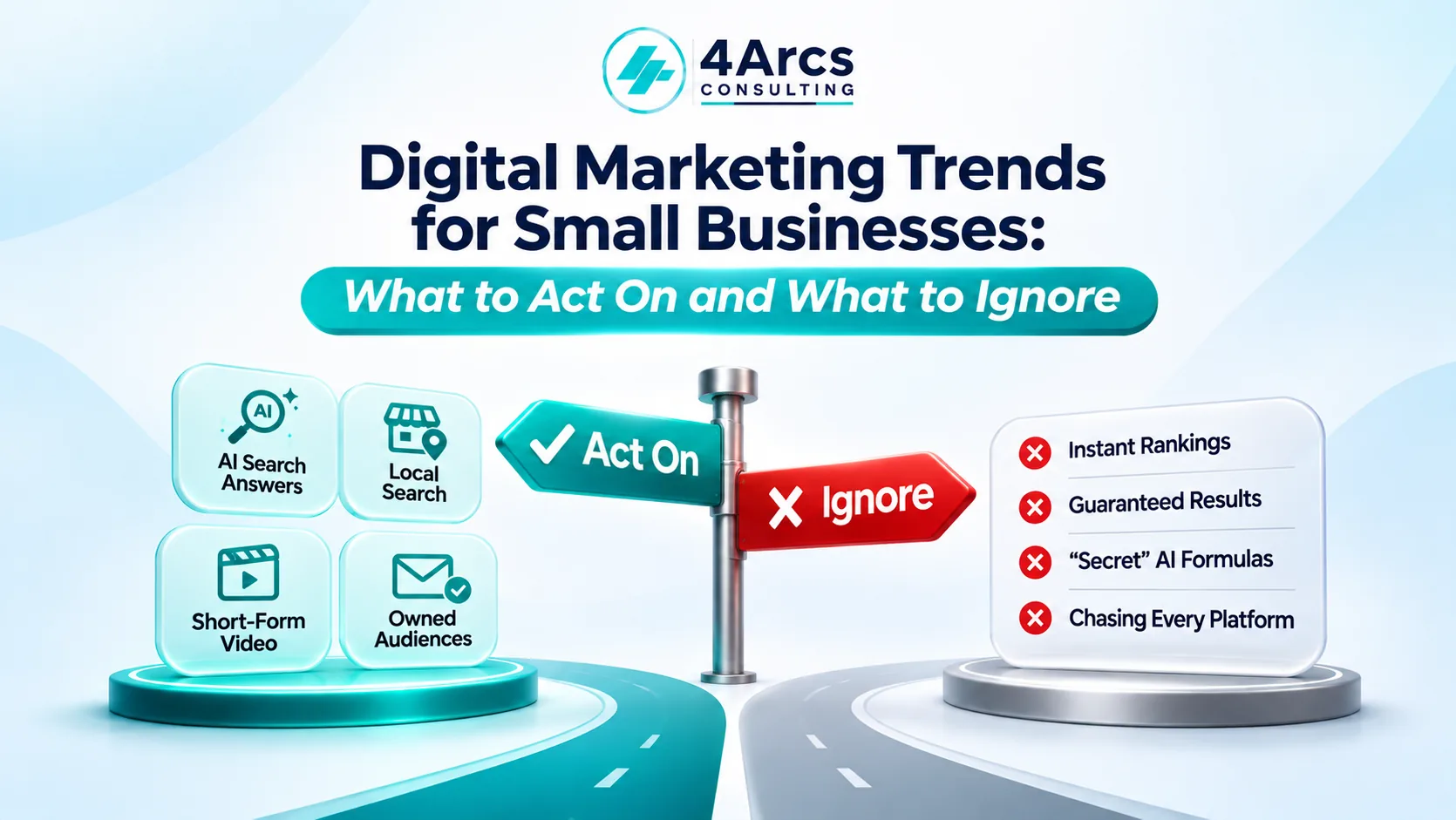
Quick Answer: The digital marketing trends for small businesses that deserve a budget are AI-generated search answers, local search, short-form video, and audiences you own, such as email lists. Respond with clear answer-first pages, a complete business profile, and honest advertising. Pick one trend, test it for a quarter, and measure leads, not activity.
Key Takeaways
- Write answer-first pages that people and AI tools can quote.
- Keep your local profile complete and your reviews flowing.
- Build an audience you own through email and your website.
- Test one trend per quarter and measure leads.
- 4Arcs Consulting includes search engine optimization among its services for small businesses.
In This Guide
- How Are AI Answers Changing How People Find Businesses?
- What Does That Mean for Your Pages?
- Why Does Local Search Carry More Weight?
- Should Small Businesses Use Short-Form Video?
- Why Do Owned Audiences Matter More Over Time?
- How Should You Measure Results Without Perfect Tracking?
- Which Trends Have Evidence Behind Them, and Which Are Hype?
- How Do You Choose What to Act On?
- What Do Real Marketing Results Look Like?
- What Should You Be Careful About?
- What Does a Practical Quarterly Plan Look Like?
- Conclusion
How Are AI Answers Changing How People Find Businesses?
Search tools increasingly summarize answers and cite sources, so a customer may read a generated summary before they visit your website. Google’s documentation on AI features says no special optimization is needed beyond standard search best practices. As a result, clear, accurate, helpful pages remain your best preparation.
Read Google’s AI features and your website guidance (last updated December 10, 2025). However, no tactic can guarantee that an AI tool will cite you.
What Does That Mean for Your Pages?
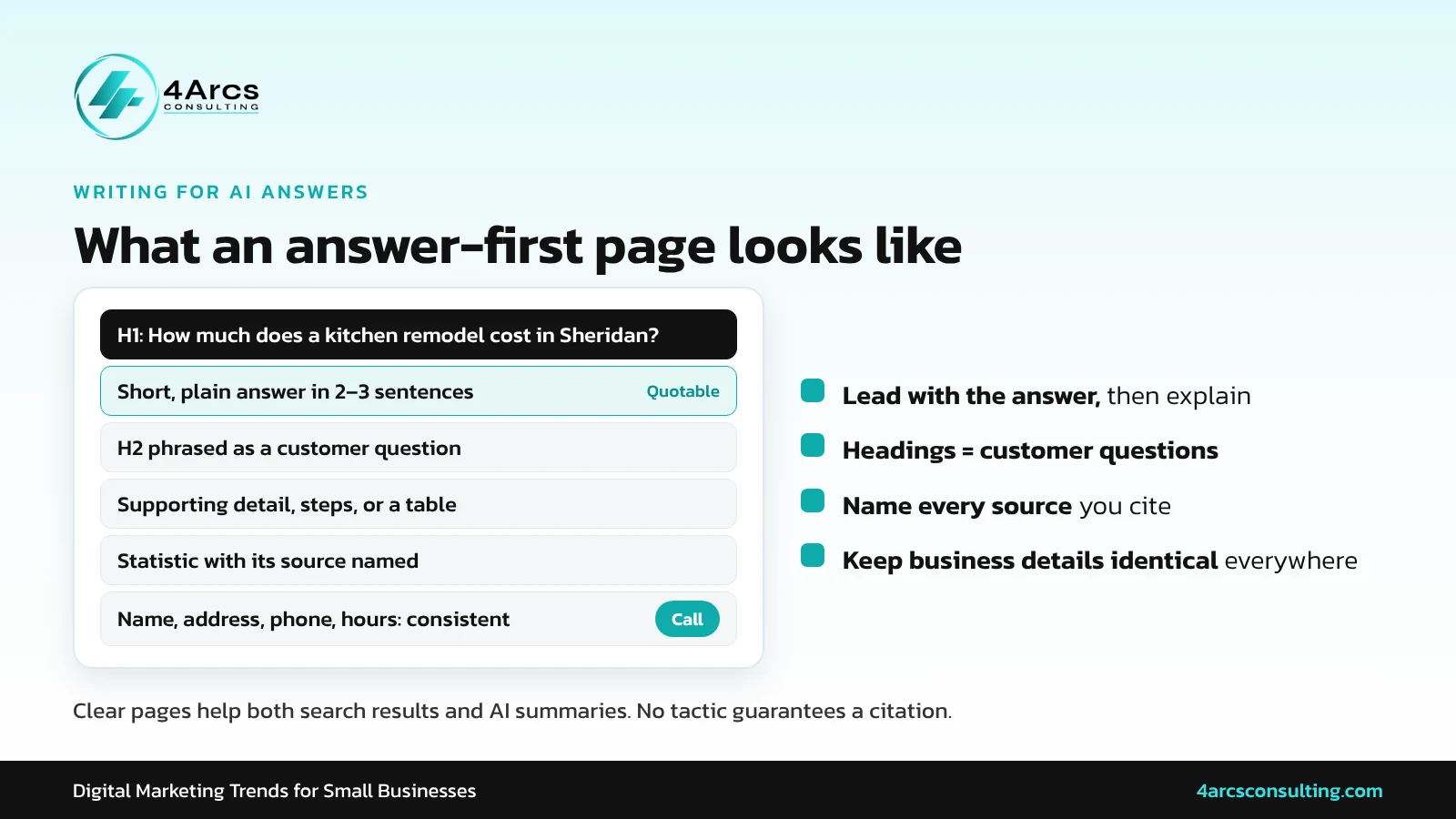
Start each page with a short, plain answer, phrase headings as questions customers ask, keep names, addresses, hours, and services consistent everywhere, and name the source when you cite a fact. In short, these habits help traditional results and AI-generated summaries equally, because both reward clear, accurate pages.
- Start each page with a short, plain answer.
- Phrase headings as customer questions.
- Keep business details consistent everywhere.
- Name the source for every statistic.
If your pages need more than a rewrite, start by fixing these common website mistakes.
Why Does Local Search Carry More Weight?
Customers search for nearby help and compare reviews before they call, so a complete, accurate profile and a steady flow of reviews can decide who gets the call. For that reason, check your hours, categories, and photos every quarter, and reply to reviews consistently so the profile looks active.
The FTC’s Endorsement Guides FAQs explain the rules that apply when you ask for and use reviews.
Should Small Businesses Use Short-Form Video?
Yes, if you can keep it simple. One customer question answered in under a minute, filmed on a phone, is enough. In addition, video shows the people behind the business and works across several platforms. Above all, the habit matters more than the equipment, and a steady schedule beats occasional polished clips.
Our social media marketing page lists Facebook, Instagram, and TikTok among the platforms we work with. For a full posting routine, see our 90-day social media plan.
Short on time for video? See how social media management can handle the routine.
Why Do Owned Audiences Matter More Over Time?
Information that customers give you directly, such as an email address, is an asset no platform can take away. In other words, email lists and your website are channels you control. Build the list with permission and follow the FTC’s CAN-SPAM compliance guide.
| Owned asset | How to grow it |
|---|---|
| Email list | Sign-up forms with a clear promise |
| Website | Pages that answer real questions |
| Customer records | Ask how people found you |
| Reviews | Request one after every job |
How Should You Measure Results Without Perfect Tracking?
Rely on what you can observe directly: form submissions, calls, booked appointments, and a “how did you hear about us?” question. Next, set these up once and review them monthly. Combine them with analytics rather than depending on any single source, because no single number tells the whole story. Our guide to measuring marketing ROI shows how to turn those numbers into a decision.
Which Trends Have Evidence Behind Them, and Which Are Hype?
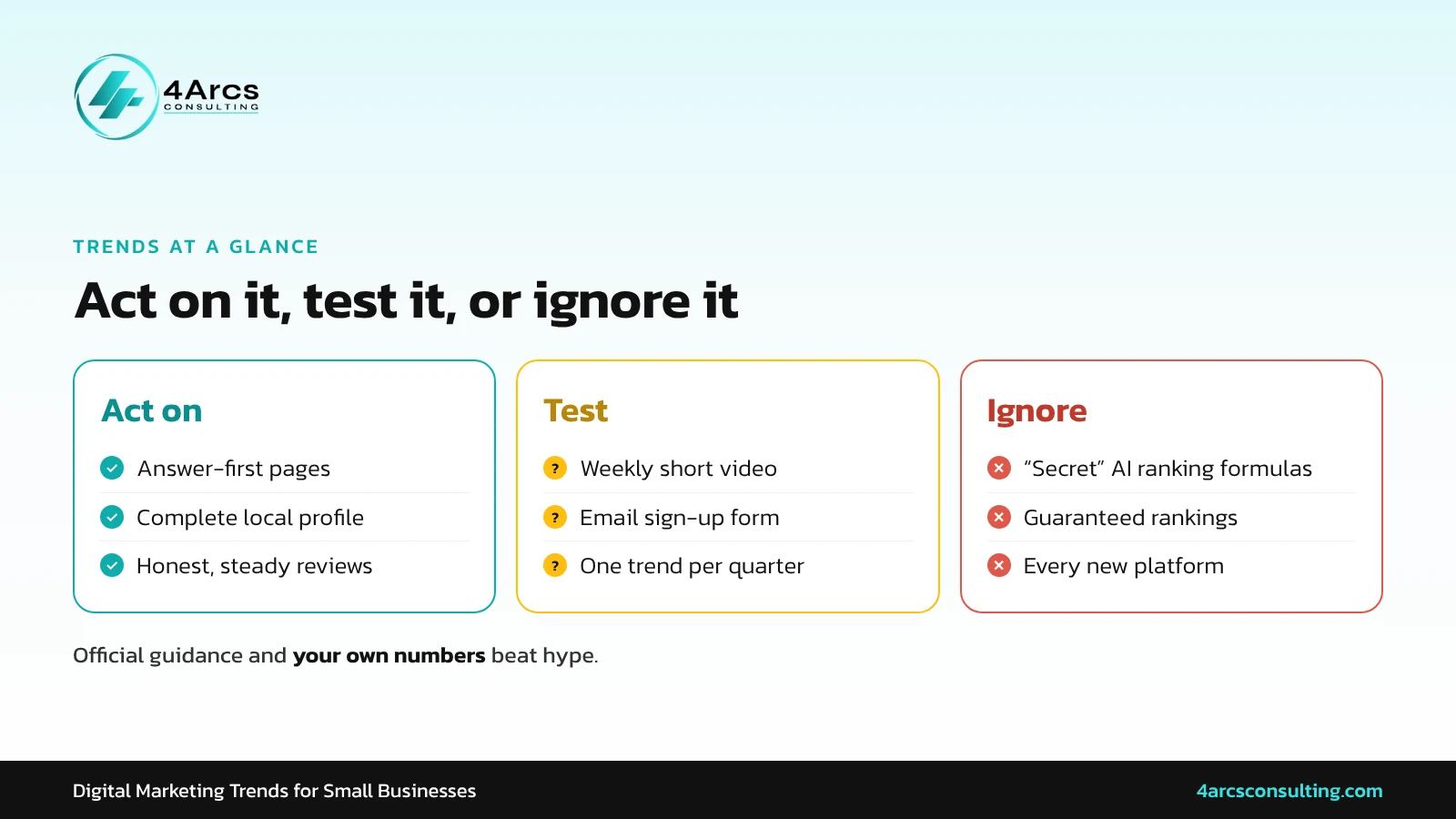
Separate each trend by the kind of support behind it. In general, official documentation is the strongest source, and your own test results come next. Anything promising instant rankings, guaranteed results, or a secret formula belongs in the hype column until you test it yourself.
| Trend | What supports it | What to do |
|---|---|---|
| AI answers | Google’s official AI features documentation | Improve page clarity, not tricks |
| Local profile and reviews | FTC rules on reviews; your own call data | Keep it complete and honest |
| Short video | No official performance claim | Test one video a week, measure leads |
| FTC CAN-SPAM rules | Build the list with permission | |
| “Secret” AI ranking formulas | Nothing official | Ignore |
How Do You Choose What to Act On?
Pick one trend and test it for a quarter, with a success measure defined before you start. Choose the option that fits your customers and your capacity, and judge results by cost per customer, not activity. Finally, if a test produces nothing after a fair trial, drop it and pick the next.
| Trend | First step | How to measure |
|---|---|---|
| AI answers | Rewrite your top three pages answer-first | Leads from those pages |
| Local search | Complete your profile | Calls and direction requests |
| Short video | One question-answer video a week | Messages and bookings |
| Owned audience | Add a sign-up form and welcome email | List growth and clicks |
What Do Real Marketing Results Look Like?
Examples help separate trends from hype, though results vary and the ones below are self-reported. Absolute Aesthetics in Denison and Intentional Wellness Medspa in Burlington both used website design, SEO, and paid social, as our success stories describe. The pages do not state timeframes.
See the Absolute Aesthetics story and the Intentional Wellness Medspa story. Results are not guarantees.


What Should You Be Careful About?
Be careful with anything promising instant rankings or guaranteed results, AI-written content published without checking every fact, chasing every platform, and tactics that rely on data collected without consent. In contrast, official guidance and your own numbers are better guides than hype.
The FTC’s advertising and marketing guidance is a useful reference for keeping claims truthful.
What Does a Practical Quarterly Plan Look Like?
A quarterly plan keeps trend-chasing under control. In the first month, fix your foundations: tracking, your local profile, and your top three pages. Next, launch one test in the second month. Then, in the third, measure the result, keep what worked, and choose the next test based on evidence.
| Month | Focus |
|---|---|
| 1 | Tracking, local profile, top three pages rewritten answer-first |
| 2 | Launch one test, such as a weekly short video or an email sign-up form |
| 3 | Measure leads and cost, then keep, change, or drop the test |
Conclusion
The digital marketing trends for small businesses worth acting on are answer-first content for AI search, a complete local presence, short video, and owned audiences. Test one at a time, set a measure in advance, and keep claims honest. A quarterly review beats chasing every new tool. 4Arcs Consulting can help you build a plan, so explore our search engine optimization service.
Want to Know Which Trend to Test First?
FAQs
Ans. AI answers draw on web content, so clear, accurate pages remain important. Google’s documentation treats AI features as part of search, not a separate discipline.
Ans. They can help with drafts, but a person should check every fact and add real experience. Unreviewed AI text risks errors.
Ans. Yes. It is a channel you own and a low-cost way to keep customers.
Ans. Check publication dates and prefer official guidance and your own data. Be skeptical of tactics tied to a single year.
Ans. Review quarterly and adjust for what the data shows. Retire anything that has not produced leads after a fair test.
Ans. No. Join a platform only if your customers use it and you can sustain a routine there.