
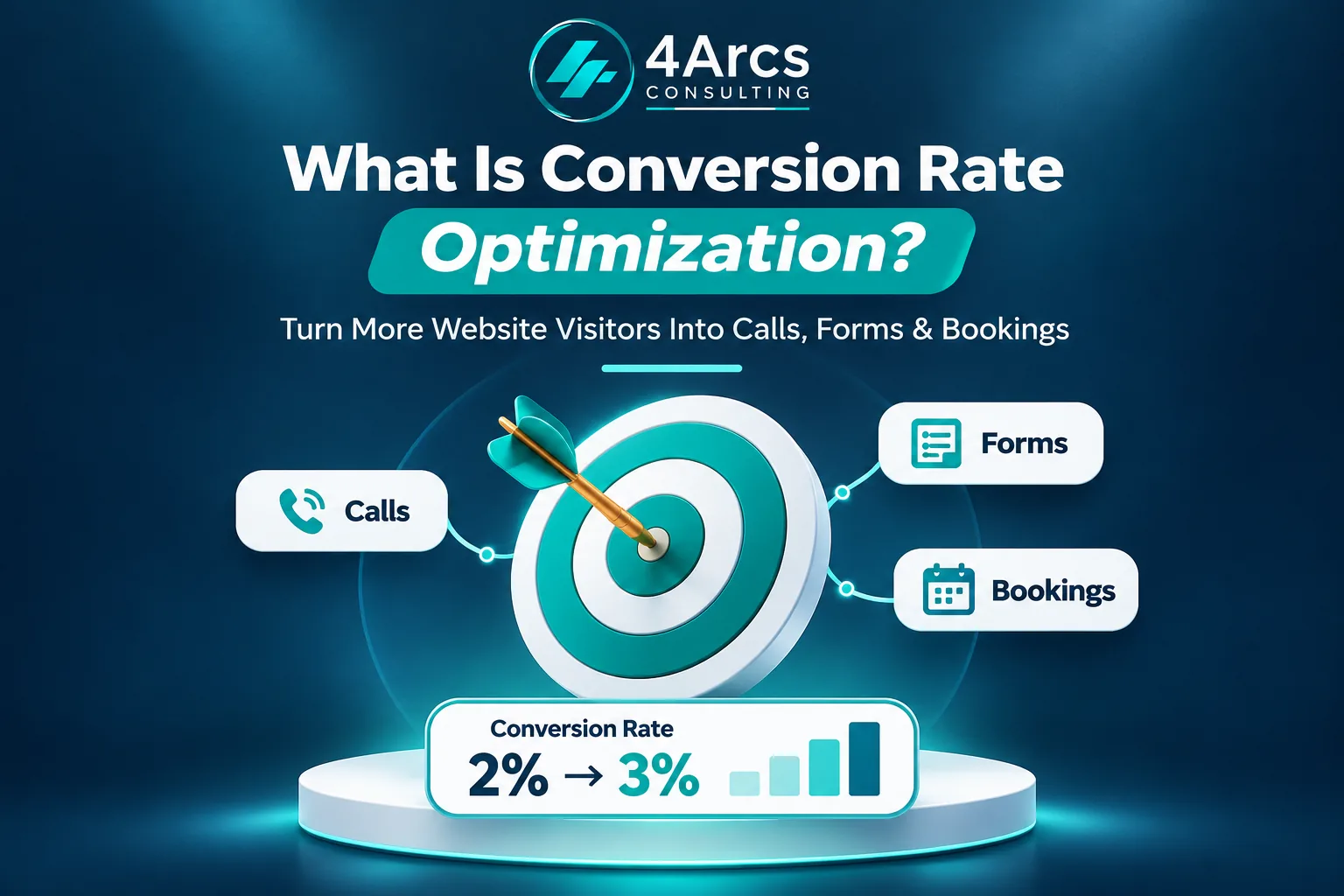
Quick Answer: What is conversion rate optimization? It is the process of improving your website so more of the visitors you already have take action, such as calling, filling out a form, or booking. Your conversion rate is conversions divided by visitors, times 100. CRO raises that rate by tracking where visitors drop off, testing fixes, and keeping what works, so you get more leads without paying for more traffic.
Key Takeaways
- CRO gets more value from the traffic you already have, while SEO and ads bring in more traffic.
- Conversion rate = conversions ÷ visitors × 100.
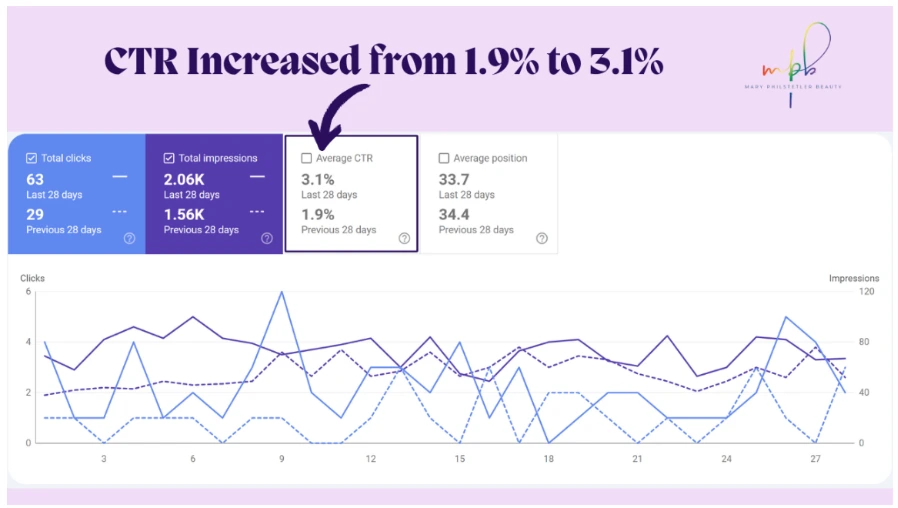
- Moving from a 2% to a 3% conversion rate means 50% more leads from the same visitors.
- Good CRO is based on real visitor behavior and testing, not guesswork.
- Quick wins include tap-to-call, shorter forms, one clear call to action, and fast mobile pages.
4Arcs Consulting helps small businesses with conversion rate optimization, website design, and SEO.
Every visitor who lands on your site is a chance you paid for, one way or another, whether through ads, Search Engine Optimization (SEO), or just time spent building the business. Most of those chances quietly disappear.
Your website gets visitors every day. The real question is what happens after they arrive. Do they fill out a form, pick up the phone, or book an appointment? Or do they look around for a few seconds and leave without doing anything?
That gap, between visitors showing up and visitors actually taking action, is exactly what conversion rate optimization is built to close.
What Is Conversion Rate Optimization?
Conversion rate optimization, or CRO, is the process of improving your website so more of your existing visitors take a meaningful action: filling out a contact form, calling your business, or completing a purchase.
Here’s the key distinction most business owners miss. CRO isn’t about getting more traffic. It’s about getting more value out of the traffic you already have. A business spending money to drive visitors to a website that quietly turns most of them away is paying twice: once for the traffic, and again for the lost sales that traffic should have generated.
A conversion is any action that moves a visitor closer to becoming a customer. Most small businesses track a few main ones:
| Conversion | Example |
|---|---|
| Phone call | A visitor taps your number on a phone |
| Form submission | A contact, quote, or appointment request |
| Online booking | A completed booking in your scheduler |
| Purchase | A completed checkout on an online store |
| Email signup | A newsletter or offer signup, a smaller first step |
How Do You Calculate Your Conversion Rate?
Divide conversions by visitors and multiply by 100. If 1,000 people visit your site in a month and 20 of them call, fill out a form, or book, your conversion rate is 2%.
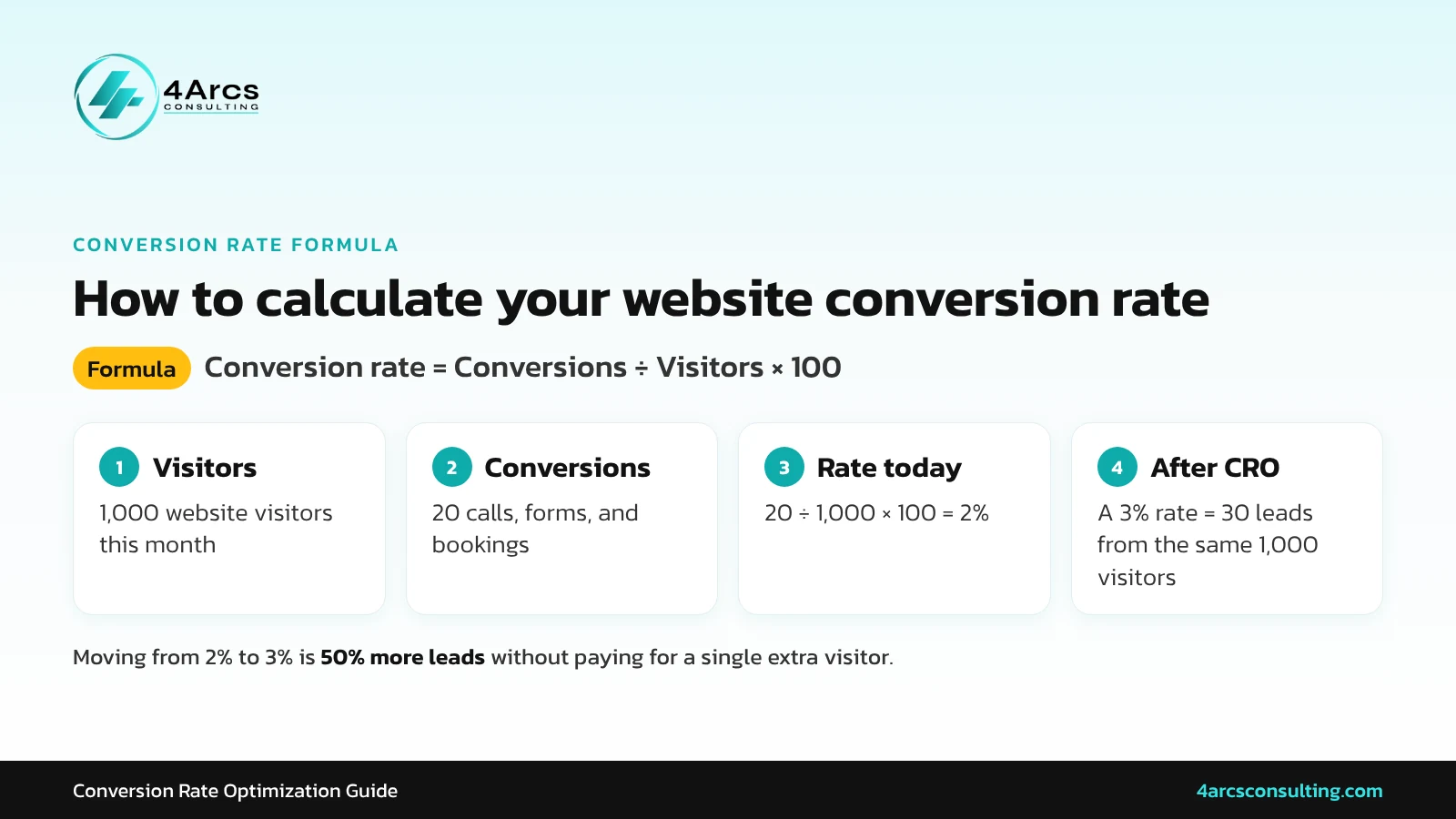
That small number matters more than it looks. If CRO lifts the rate from 2% to 3%, the same 1,000 visitors produce 30 leads instead of 20. That is 50% more leads without spending more on ads or SEO. Track the rate for the whole site and for your most important pages, such as service and contact pages, so you can see where the gains come from.
CRO Basics: How It Actually Works
Good CRO Isn’t Guesswork
It’s built on watching what real visitors actually do on your site, then making changes based on that evidence, not assumptions.
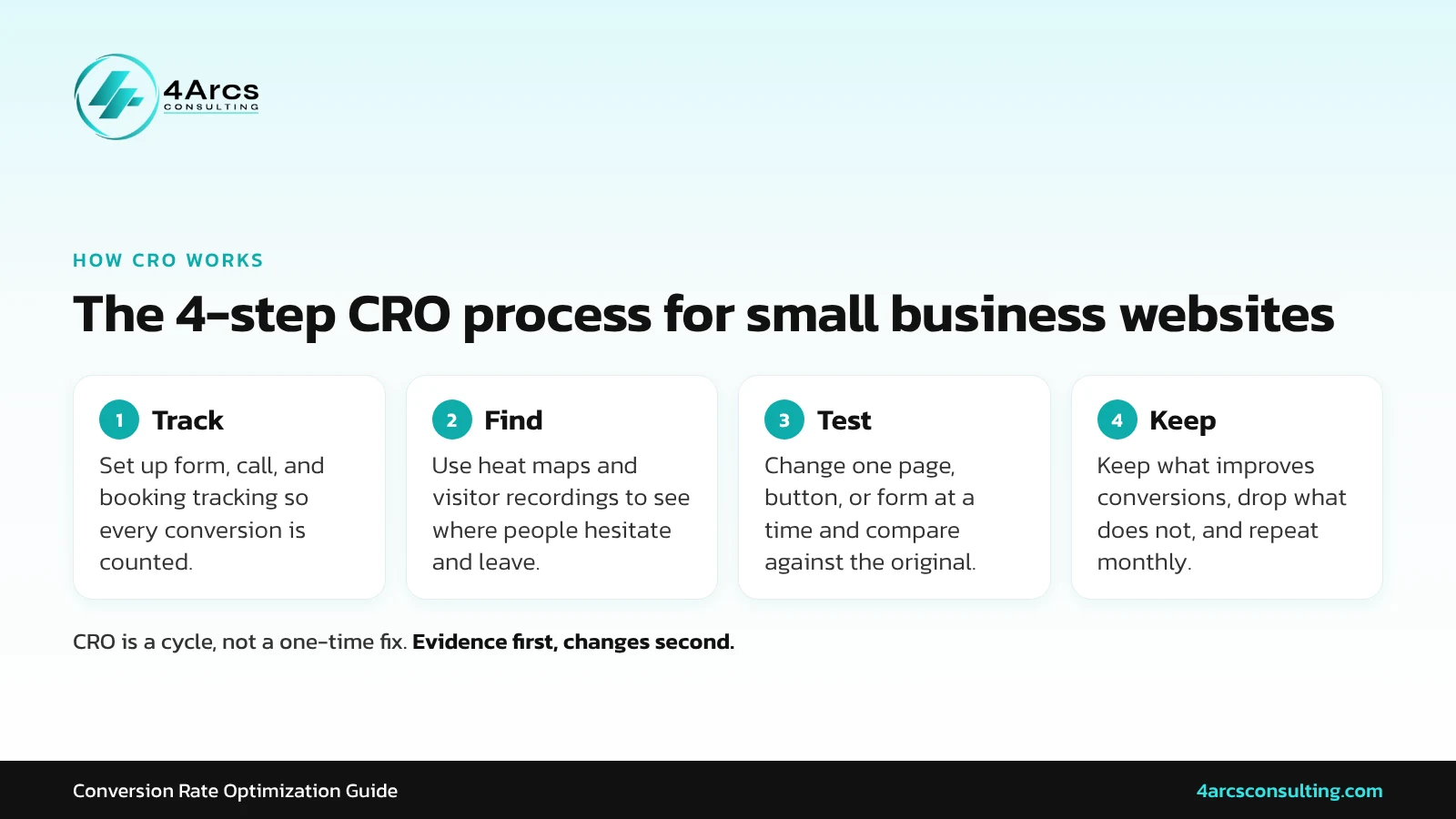
Behavior Tracking
Tools like heat maps and visitor recordings show exactly where people click, where they hesitate, and where they give up and leave. This turns “I think our site has a problem” into “here’s exactly where the problem is.”
Testing Before Permanent Changes
Nothing should get changed sitewide just because it seems like a good idea. A/B testing lets a business compare two versions of a page, button, or form, and see which one real visitors actually respond to better.
Local and Industry Context
What converts a visitor in one market or industry doesn’t always convert one somewhere else. Effective CRO accounts for a business’s actual customers, not a generic template applied to every website.
A Structured, Ongoing Process
CRO typically works best over a defined timeline: first identifying what’s actually broken, then making targeted fixes, then building on what’s working. It’s not a one-time fix-and-forget.
What If Your Site Has Low Traffic?
A/B tests need enough visitors to give a reliable answer, and many small business websites do not have that volume. In that case, focus on clear fixes backed by recordings and heat maps, such as a broken form or a hidden phone number, then compare your conversion rate over several weeks before and after each change.
Why CRO Matters for Small Business
A few things are true for nearly every small business with a website:
Many customers check a business’s website before they call, visit, or buy. That makes your website the deciding step: if it loads slowly, hides the phone number, or feels generic, the visitor moves on to a competitor. Each of those problems can be found and fixed.
For a small business specifically, CRO tends to matter even more than it does for a large company. Small businesses usually can’t outspend competitors on advertising volume. Getting more conversions out of the traffic already coming to the site is often the more efficient, lower-cost lever to pull, compared to paying more to generate new traffic that converts at the same low rate.
What Are the Quickest CRO Wins for a Small Business Website?
Start with fixes that remove friction on your highest-traffic pages. These changes cost little and often lift conversions, but measure each one rather than assuming it worked.
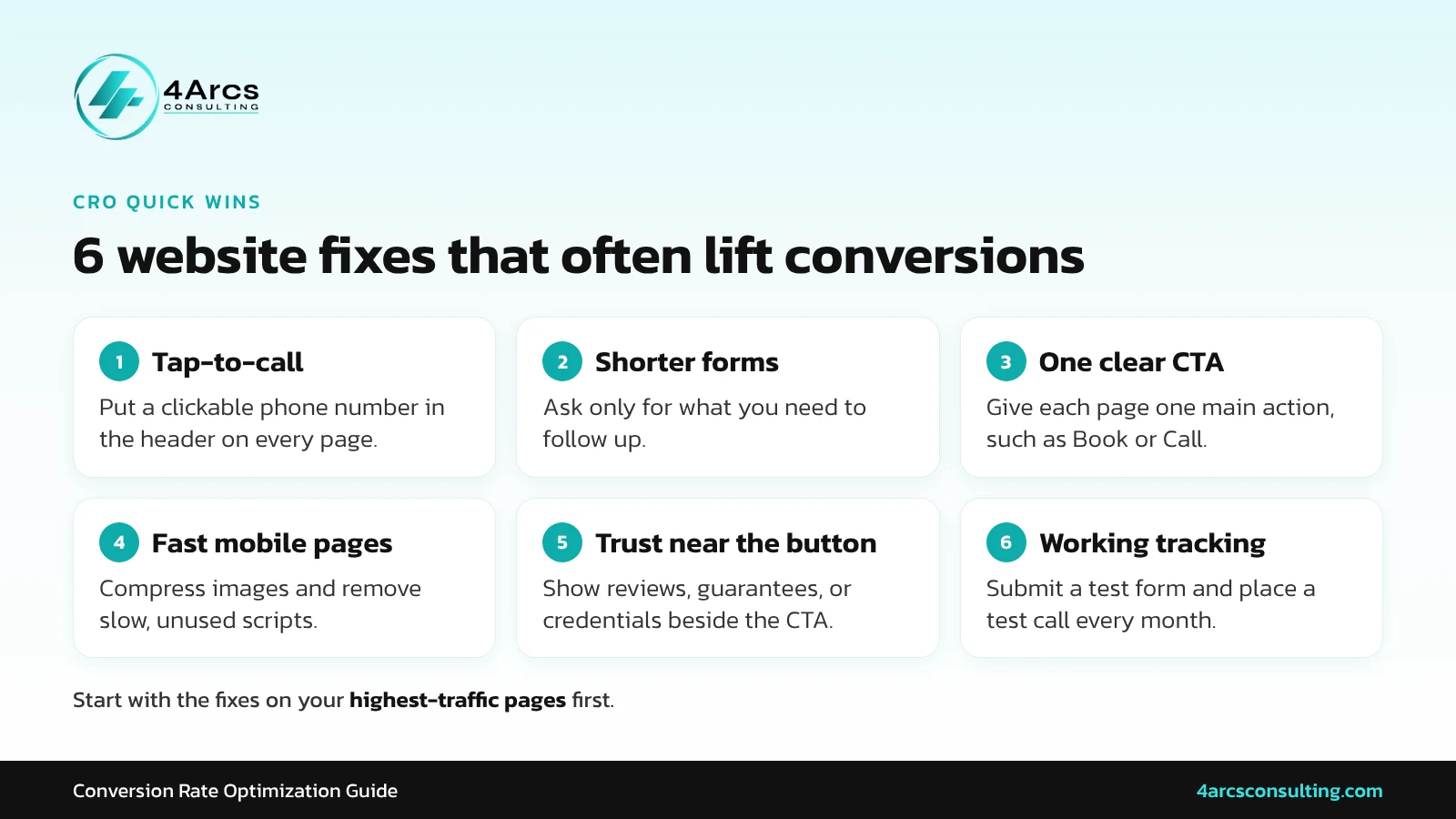
- Add a tap-to-call phone number to the header of every page.
- Shorten forms to the fields you need to follow up.
- Give each page one main call to action, such as Book or Call.
- Speed up mobile pages by compressing images and removing unused scripts.
- Place reviews, guarantees, or credentials near the main button.
- Submit a test form and place a test call every month to confirm tracking works.
What CRO Actually Does for a Business
In practical terms, conversion rate optimization:
- Identifies exactly where visitors are dropping off, instead of guessing
- Fixes forms, buttons, and page layouts that are quietly costing conversions
- Improves the mobile experience, since a large share of visits now happen on a phone
- Maps the full customer journey, not just a single page in isolation
- Provides clear reporting so a business owner can see what changed and what it actually did
The end goal is straightforward: turn an underperforming website into an asset that actively brings in customers, more bookings, more calls, more form submissions, from the same traffic a business is already getting.
How Is CRO Different From SEO?
SEO brings more of the right visitors to your site, and CRO turns more of those visitors into customers. They work best together, because better rankings send traffic to pages that are ready to convert.
| SEO | CRO | |
|---|---|---|
| Goal | More qualified visitors | More actions from each visitor |
| Main work | Content, technical fixes, and local listings | Tracking, page and form fixes, and testing |
| Main measures | Rankings, search traffic, and calls from search | Conversion rate, leads, and cost per lead |
| Timeline | Usually builds over months | Clear fixes can show results sooner |
How Do You Measure CRO Results?
Measure the actions that matter, not just page views. Set up conversion tracking in Google Analytics, use call tracking for phone leads, and compare results before and after each change. To see whether the extra leads are profitable, use the formulas in our guide to marketing ROI for small businesses.
- Conversion rate for the whole site and for key pages
- Number of leads by type: calls, forms, and bookings
- Cost per lead
- Bookings or revenue from those leads
How 4Arcs Consulting Approaches CRO
4Arcs Consulting builds conversion rate optimization around real visitor behavior, not assumptions. That starts with watching how actual visitors interact with a site through recordings and heat maps, then testing changes before they go live sitewide, so nothing gets changed based on a guess.
The process typically runs across a few months: first identifying what’s actually holding a site back, then making targeted, tested improvements, then building on what’s proven to work. Every client gets monthly reporting in plain language, not technical jargon, so it’s always clear what changed and what results it produced.
Conclusion
Conversion rate optimization helps you get more calls, forms, and bookings from the visitors you already have. Start by tracking every conversion, work out your current rate, fix the obvious friction on your busiest pages, and measure each change. For a small business that cannot outspend competitors on traffic, CRO is often the most efficient way to grow.
Ready to See Where Your Website Is Losing Customers?
Most business owners can sense something isn’t converting the way it should, but can’t pinpoint exactly why. A free audit gives you that answer: a real, specific look at where visitors are dropping off and what to fix first.
FAQs
Ans. It’s the process of improving your website so more visitors take action, like filling out a form or making a purchase, instead of leaving without doing anything.
Ans. SEO focuses on getting more visitors to your site. CRO focuses on getting more value from the visitors you already have. Most businesses benefit from both working together.
Ans. It depends on your industry, traffic source, and what you count as a conversion, so there is no single target. The most useful benchmark is your own: measure your current rate, then aim to improve it month over month.
Ans. Yes, often more so than for larger companies. Small businesses typically can’t outspend competitors on traffic volume, so improving what happens after a visitor arrives is usually the more efficient investment.
Ans. Many businesses start seeing more inquiries within the first month, as obvious problems get fixed. Deeper, tested improvements typically build over a few months.
Ans. Yes. With fewer visitors, formal A/B tests take longer, so focus on clear fixes backed by visitor recordings, then compare results over several weeks.
Ans. No. Most CRO work, such as tracking, testing, and targeted fixes, happens behind the scenes without requiring the business owner to touch any code.


What do you think?
[…] comparing agency quotes, read how to measure marketing ROI for a small business so you know which results to ask […]
Comments are closed.