
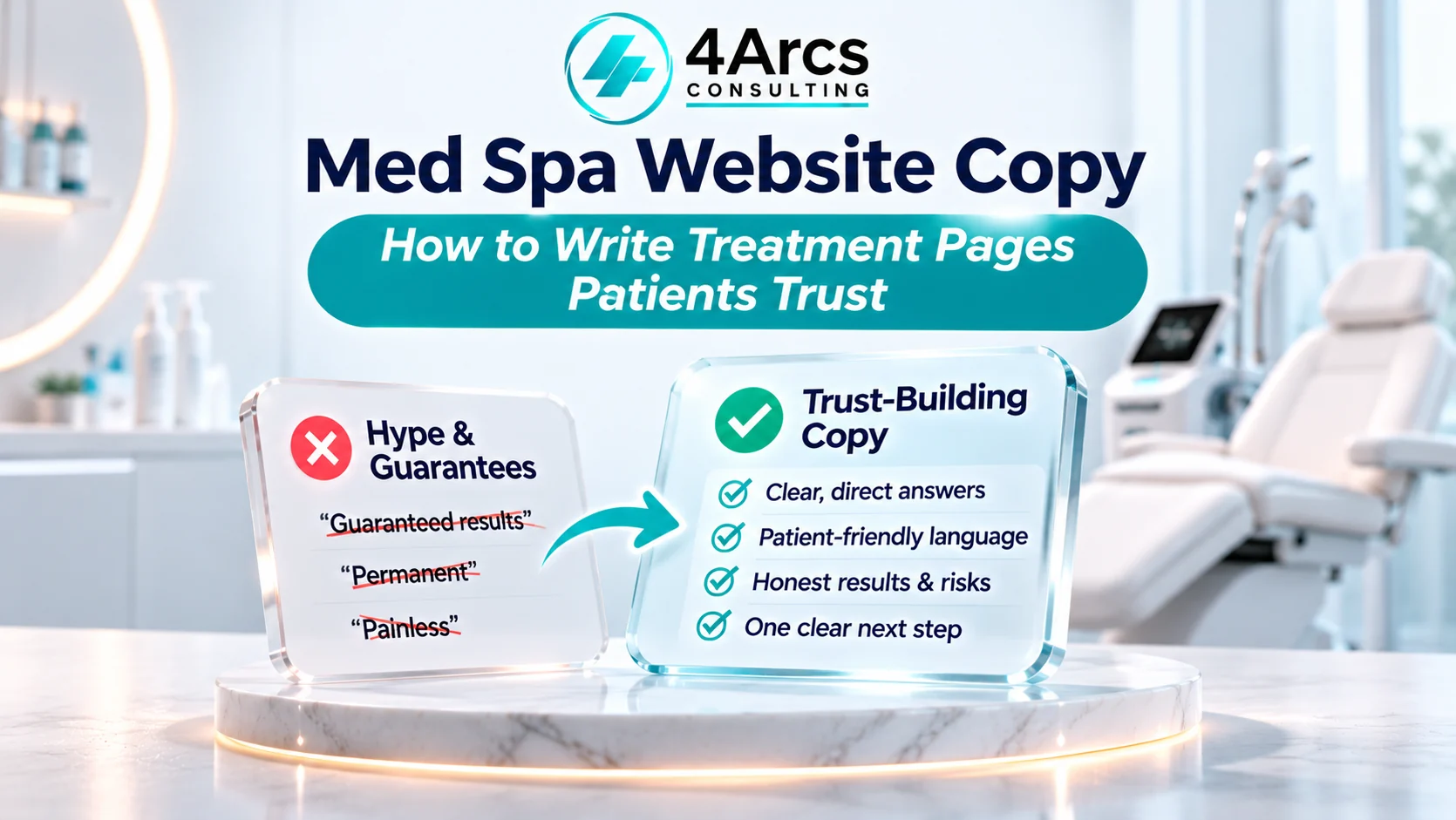
Quick Answer: Good med spa website copy opens each treatment page with a direct answer, uses the words patients use, explains results and risks honestly, and ends with one clear next step. Avoid guarantees and exaggerated claims, because the FTC requires advertising to be truthful and supported by evidence. Use the rewrites and checklist below to edit your pages.
Key Takeaways
- Open each treatment page with a plain, direct answer.
- Use patient language, and define clinical terms once.
- Replace guarantees with honest descriptions of what varies.
- End every page with one clear next step.
- 4Arcs Consulting designs med spa websites with consultation request forms and galleries.
In This Guide
- How Should a Med Spa Treatment Page Begin?
- What Language Should Med Spa Website Copy Use?
- What Can You Say About Results?
- How Do You Cover Risks and Recovery?
- Which Proof Belongs in the Copy?
- How Do You Write Headings Patients Search?
- What Should the Call to Action Say?
- What Should You Check Before Publishing a Treatment Page?
- Conclusion
How Should a Med Spa Treatment Page Begin?
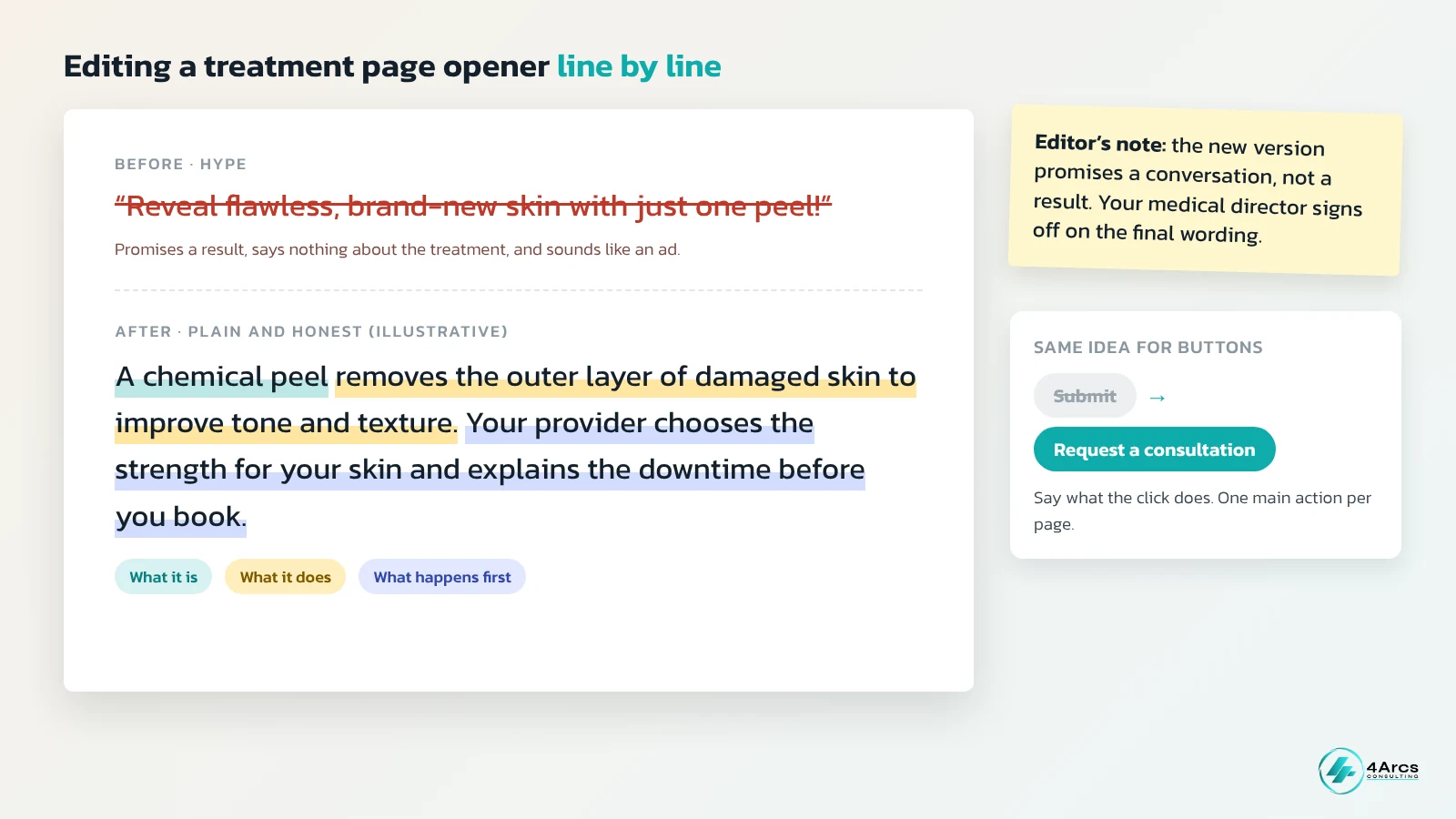
Begin with a direct answer in two or three sentences: what the treatment is, what it is used for, and what happens first. Patients arrive with a question, and the first lines should answer it. Hype in the opening sends them back to search results.
| Weak opener (illustrative) | Stronger opener (illustrative) |
|---|---|
| “Experience our luxurious, transformative facial that will make you glow!” | “A medical facial cleans, exfoliates, and hydrates the skin. Your provider reviews your skin first and recommends a treatment that suits you.” |
| “Turn back the clock with unbeatable wrinkle-erasing injectables!” | “Wrinkle-relaxing injectables soften lines caused by muscle movement. A provider examines you, explains the risks, and advises whether treatment suits you.” |
| “Say goodbye to unwanted hair forever!” | “Laser hair removal reduces hair growth over a series of sessions. The number of sessions varies with hair and skin type.” |
These examples are illustrative. Notice what changed: the stronger versions say what the treatment is, what it is for, and what happens first, and they promise a conversation, not a result. Have your medical director approve the final wording for your own services. Our website best practices checklist covers page structure.
What Language Should Med Spa Website Copy Use?
Write the way patients talk. Use their words for concerns, explain clinical terms once, and keep sentences short. Replace vague hype such as “transformative” and “luxurious” with facts about what happens, how long it takes, and who the treatment suits. Plain language reads as honest, and honesty builds trust in a medical setting.
- Use the patient’s word first, then the clinical term
- Keep sentences under about 20 words
- Replace adjectives with facts
- Avoid abbreviations patients do not know
Plain, specific pages also give patients more reasons to get in touch. For Mary Philstetler Beauty, a med spa in Deerfield, Massachusetts, we created medical content and service-specific pages, and the med spa saw a 181% increase in online inquiries. Results vary by med spa.
What Can You Say About Results?
Say what you can support, and describe what varies. The FTC says advertising must be truthful and not misleading, and that claims need evidence behind them. Avoid promises about outcomes, permanence, or lack of discomfort, because they set expectations that individual patients may not meet.
| Risky phrase | Why it is risky | Safer wording |
|---|---|---|
| “Guaranteed results” | No outcome can be guaranteed | “Results vary by patient” |
| “Permanent” | Effects fade or vary | “Long-lasting for many patients; your provider will explain what to expect” |
| “Painless” | Comfort varies | “Your provider will explain comfort options” |
| “No downtime” | Recovery varies | “Recovery varies. Here is what to expect” |
| “FDA-approved” | Applies to specific products and uses | Name the product and use, only if true |
The FTC’s advertising and marketing guidance is a good starting point. The FDA lists the dermal fillers it has approved, so check any product claim against it.
Need pages that explain without overpromising? See our med spa website design service.
How Do You Cover Risks and Recovery?
Describe risks and recovery plainly, using information from your own protocols and product labeling. Patients who read honest information before they visit arrive better prepared and ask better questions. Leaving risks out damages trust and creates problems later. Have your medical director review everything on this part of the page.
- List common side effects and how long they usually last.
- Say who may not be a good candidate.
- Explain what recovery looks like in the first days and weeks.
- Say when a patient should call you.
- Point to the consultation for personal advice.
Which Proof Belongs in the Copy?
Place proof where a patient is deciding: provider names and training, real reviews, and consented results next to the call to action. Google’s guidance on helpful content recommends making authorship clear and sources visible. Provider bios and credentials do that work for a treatment page.
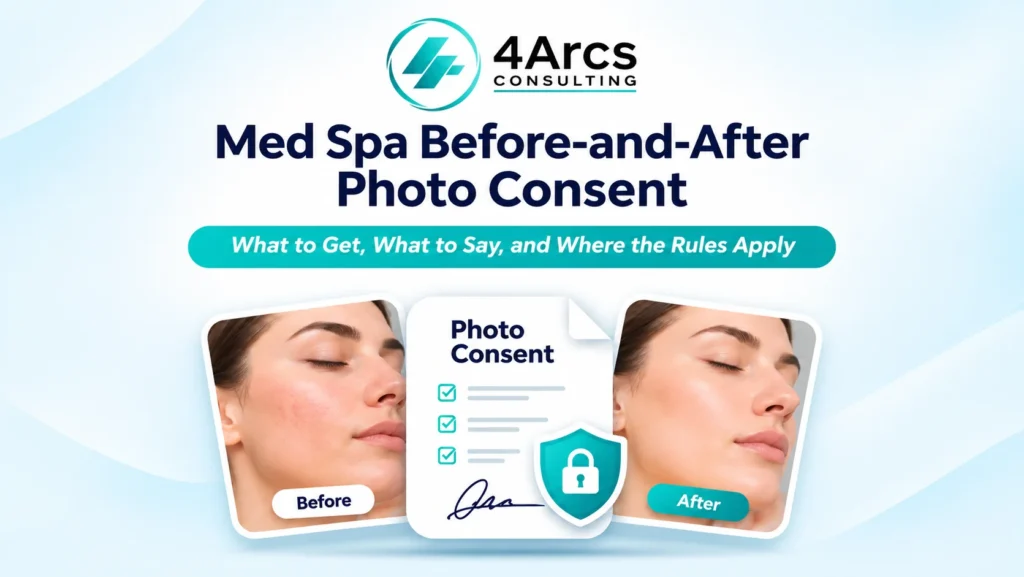
See Google’s helpful content guidance, last updated October 5, 2026. Use patient photos and quotes only with written permission, and label results honestly. Our photo consent guide covers the form and the log.
Here is what that looks like on a real med spa site. For Absolute Aesthetics, a med spa in Denison, Texas, we built custom landing pages on an SEO-friendly site structure, and the med spa reached page 1 of Google with a 131% increase in organic traffic. Results vary by med spa. Its founder, Jason Badgett, wrote about the website on our Google Business Profile:
★★★★★
“Their professionalism and expertise took my website to an entirely new level.”
Jason Badgett, founder of Absolute Aesthetics, Google review of 4Arcs Consulting
How Do You Write Headings Patients Search?
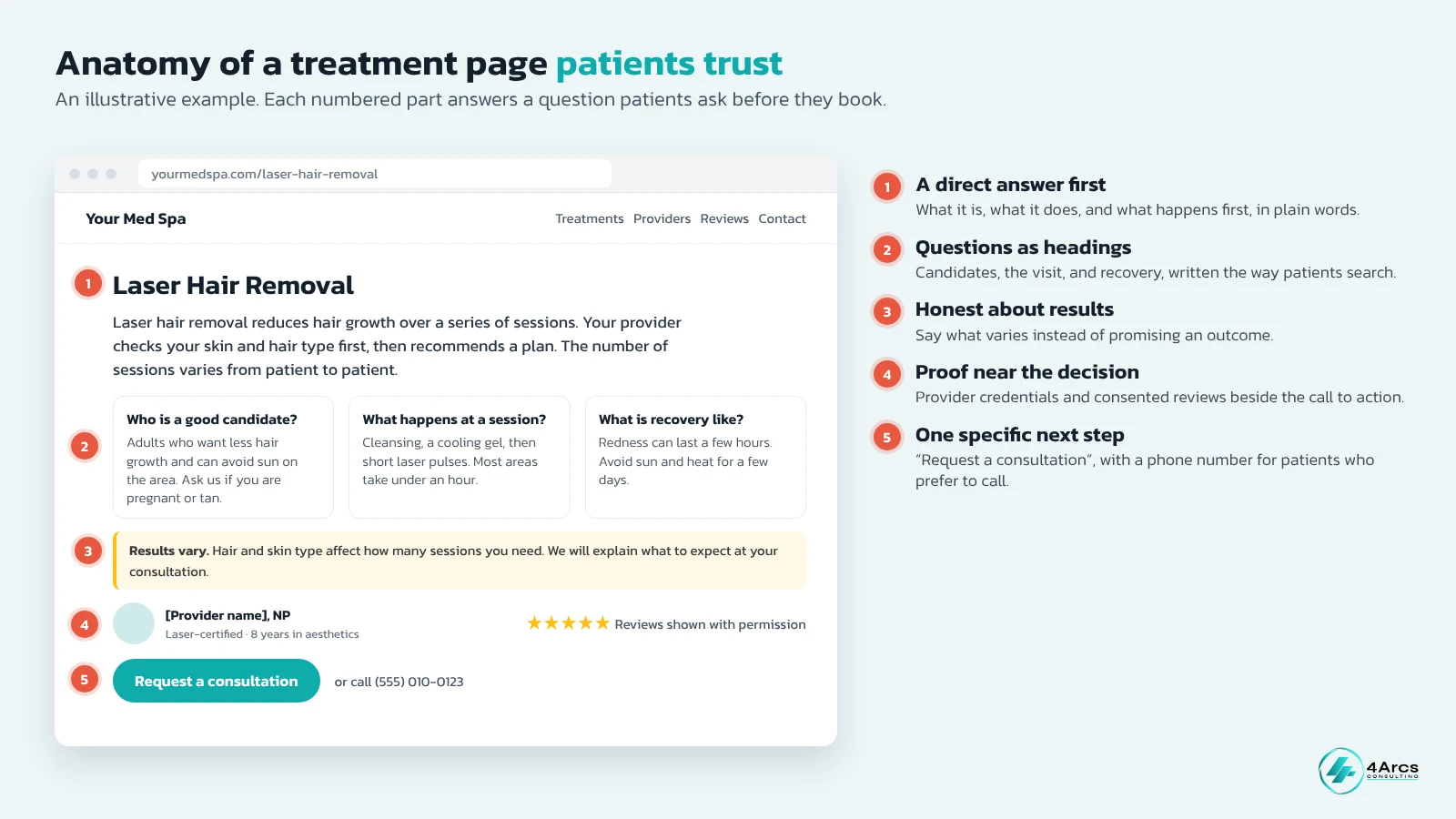
Write headings as the questions patients ask, such as “How long does recovery take?” or “Who is a good candidate?” Question headings match how people search and let a reader scan to the answer. Our med spa SEO services build treatment pages around these questions. Keep each heading specific to one question, and put the answer in the first sentence under it. Our med spa SEO keywords guide shows how to choose them.
- How long does recovery take?
- Who is a good candidate?
- What affects the price?
- What are the risks?
What Should the Call to Action Say?
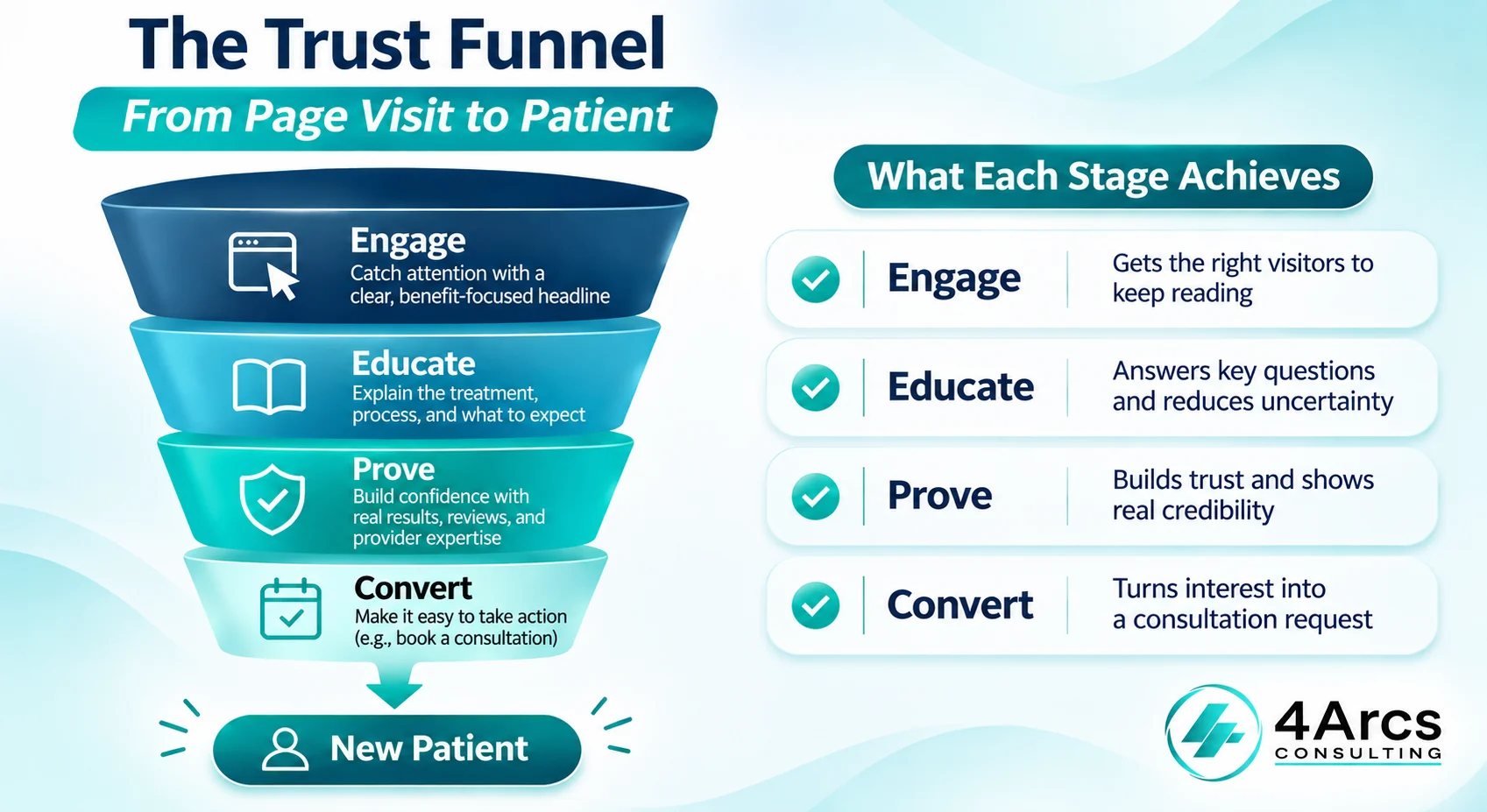
Say what happens next, in specific words. “Request a consultation” tells the patient what the click does, while “Submit” does not. Use one main action per page, and keep a phone number nearby for patients who prefer to call. Repeat the same action at natural stopping points. Testing that wording is part of our conversion rate optimization work.
| Weak | Stronger |
|---|---|
| Submit | Request a consultation |
| Click here | Book a skin consultation |
| Learn more | See what happens at your first visit |
Clear pages and a clear next step work together. For Intentional Wellness Medspa, a med spa in Burlington, Massachusetts, we built a professional website with online booking and lead capture optimization, and the med spa saw a 127% increase in organic website traffic. Results vary by med spa.
Patients notice when a site is easier to use. Another med spa owner wrote:
★★★★★
“They were able to update my website making it more user friendly.”
Michelle Ohonba, Google review of 4Arcs Consulting
What Should You Check Before Publishing a Treatment Page?
Run every page through the same checklist before it goes live. It takes only a few minutes and catches common problems, including claims that slipped in during editing. At 4Arcs, we build med spa sites with custom consultation request forms, before-and-after galleries, and a client review section, so copy and layout work together.
- Does the page open with a direct answer?
- Is every claim supportable?
- Are guarantees and absolute words gone?
- Are risks and recovery explained?
- Are provider names and credentials visible?
- Is there one clear next step?
- Did your medical director review it?
- Do headings match how patients ask?
Conclusion
Strong med spa website copy answers the patient’s question first, uses plain words, explains risks and recovery honestly, and ends with one clear next step. Replace guarantees with what you can support, and have your medical director review every claim. Use the checklist on every page before it goes live. For a second set of eyes on your pages, request a free audit.
Want a Copy Review?
FAQs
Ans. Long enough to answer the patient’s questions, and no longer. Length alone is not a goal.
Ans. No. Use their information for facts, but write your own copy, because their text may be protected and appears on many other sites.
Ans. Review them quarterly and whenever protocols, prices, providers, or product details change. Note the review date in a simple content log.
Ans. Yes. Bios with training and credentials help patients choose, and they show who stands behind the page.
Ans. Yes, with three to five real questions patients ask. Skip questions you invented.
Ans. Sparingly, and never in place of facts. Patients want to know what happens, not just how it feels.
Ans. You can use it for a first draft, but a person must check every fact and claim. Google says appropriate use of AI is not against its guidelines, while content made mainly to manipulate rankings breaks its spam policies. Have your medical director approve the final page.

What do you think?
[…] weighing whether your website itself is holding you back, our related guide on why every small business needs a high-performing website breaks that down […]
[…] For why the website comes first, see why every small business needs a high-performing website. […]
[…] A strong site also lifts returns; see why every small business needs a high-performing website. […]
[…] Compress images, remove unused plug-ins, and test on a real phone over mobile data. For more on layout and readability, see why a high-performing website matters. […]
Comments are closed.