By the 4Arcs Consulting Team. Last updated: November 25, 2026
Med Spa Web Design Trends 2026
Quick Answer
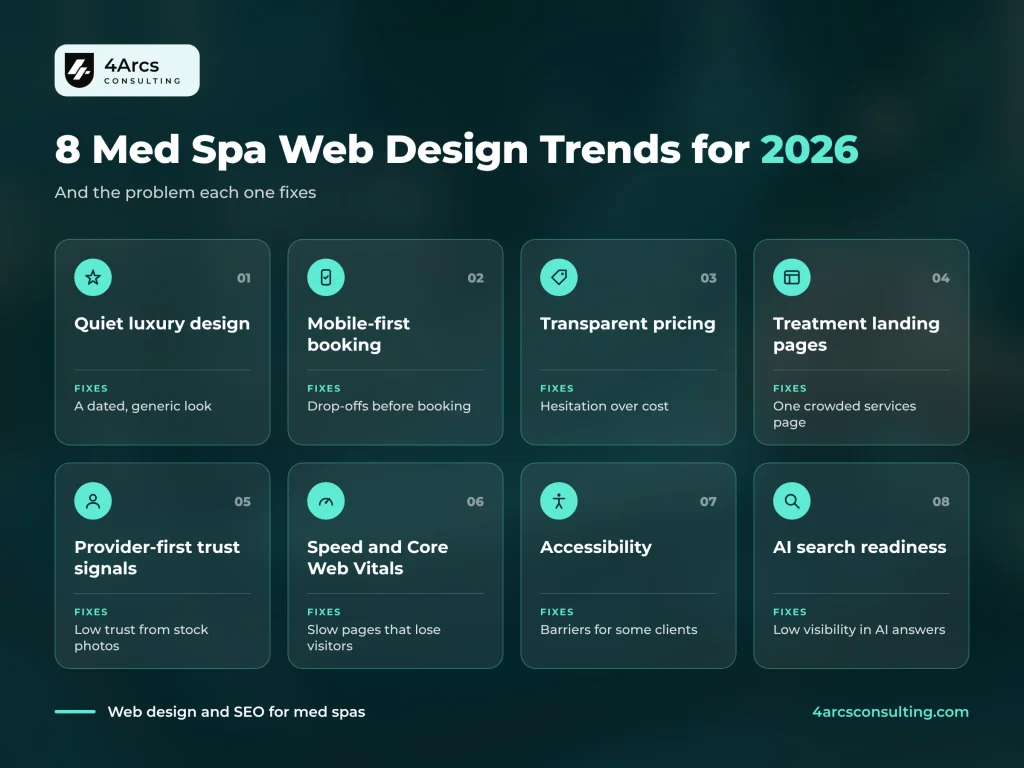
The top med spa web design trends for 2026 are quiet luxury design, mobile-first booking, transparent pricing, treatment-specific landing pages, provider-first trust signals, fast page speed, accessible design and structure for AI search. Together, they make it easier for the right clients to trust your med spa and book online.
Key Takeaways
Most clients judge your med spa website on their phone, so booking should take one tap from any page.
Calm, editorial design and real provider photos build more trust than stock imagery.
Clear pricing and a dedicated page for each core treatment answer questions before clients call.
Speed, accessibility and FAQ schema help both visitors and search engines, including AI tools.
You don’t need every trend at once. Start with your booking path, page speed and treatment pages.
Med spa web design plays a crucial role in how potential clients perceive your brand, evaluate your credibility, and decide whether to book an appointment. Before speaking to your front desk, most prospective clients will visit your website, often on their phones. Within seconds, they begin deciding whether your practice feels professional, trustworthy, and easy to book.
The competition for that first impression keeps growing. The American Med Spa Association’s 2026 industry report puts the medical aesthetics industry at more than $17 billion, with growth of over $1 billion a year. Clients have more options than ever, and a dated website gives them a reason to keep scrolling.
This guide breaks down the eight trends shaping med spa websites in 2026, what each one looks like on a real site, and where to focus.
Med Spa Web Design Trends at a Glance
No.
Trend
The problem it solves
How 4Arcs helps
1.
Quiet luxury and editorial design
A dated or generic look
Brand-aligned palettes, typography, and layouts
2.
Mobile-first booking
Visitors who leave before they book
Mobile-first builds with booking platform integration
3.
Transparent pricing
Hesitation over unknown costs
Clear pricing, membership and financing pages
4.
Treatment landing pages
One crowded services page
A dedicated, SEO-ready page for each core treatment
5.
Provider-first trust signals
Low trust from stock imagery
Provider bios, review placement, and trust-focused layouts
6.
Speed and Core Web Vitals
Slow pages that lose visitors
Image optimization and performance audits
7.
Accessibility
Barriers for clients with disabilities
Contrast checks, alt text, and accessible forms
8.
AI search readiness
Low visibility in AI answers
FAQ schema, local business schema and structured content
1. Quiet Luxury and Editorial Design
Bright white pages and gold script logos are giving way to calmer, more confident brands. Many med spas now use muted palettes such as warm neutrals, sage green, deep navy, or soft blush. Some go darker for a private-club feel.
Typography is borrowing from fashion and editorial publishing: elegant serif headlines, clean sans-serif body text, and plenty of whitespace. The goal is balance. Your site should feel premium while still reading as a professional clinical practice, not a day spa.
A practical starting point is to choose two or three brand colors and one type pairing, then use them consistently across your website, social media, and in-clinic materials.
2. Mobile-first, Frictionless Booking
According to the Pew Research Center, about 91% of U.S. adults own a smartphone. Most of your visitors will meet your brand on a small screen, often between errands or on a lunch break.
Mobile-first med spa web design in 2026 means:
A “Book a Consultation” button above the fold on every page
A sticky booking button that stays visible while visitors scroll
Online booking that connects to your scheduling platform, such as Boulevard, Zenoti, Aesthetic Record, or Mangomint
Short forms that only ask for what you need at this stage
Tap-to-call and directions links for clients who prefer to talk first
Every extra step between “I’m interested” and “I’m booked” is a chance to lose a visitor. Test the path on your own phone.
AI chat and booking assistants can support your front desk, even after hours:
Answer routine questions and explain how consultations work.
Guide visitors to available appointments by connecting to your scheduling platform.
Protect patient privacy. If an assistant handles protected health information (PHI), verify that the vendor, configuration, and data-handling practices meet applicable HIPAA requirements. Avoid collecting sensitive medical details through an ordinary website chatbot.
8 Med Spa Web Design Trends for 2026
3. Transparent Pricing
Not knowing the cost is one of the most common reasons first-time clients hesitate. More med spas now show pricing on their websites, whether as flat rates, “starting from” prices, packages, or membership options.
You do not have to publish every number. A clear range for popular treatments, or a short explanation of how consultations and pricing work, removes much of the guesswork. Keep prices current and check promotional wording against your state’s advertising rules.
If you offer memberships or financing, give each its own simple page. Clients can then compare options on their own time instead of calling to ask.
4. Treatment-specific Landing Pages
One long “Services” page is fading out. Leading med spa websites give each major treatment its own page and group those pages the way clients think: face, skin, body, and wellness.
A strong treatment page covers what the treatment is, who it is typically for, what to expect at the appointment, pricing guidance, common questions, and a booking button. It helps visitors find answers faster and gives search engines a dedicated page to show for that treatment in your area. It also gives your paid ads a relevant landing page instead of your homepage. A well-structured treatment page is one part of an effective website strategy. Explore our med spa website design services to learn how a treatment-focused website can support your practice’s growth.
Not sure where your site stands?
At 4Arcs Consulting, we will review your med spa website and show you what to fix first: booking flow, treatment pages, speed, and more.
Leading med spas now swap stock photos of models for real photography of their providers, treatment rooms, and front desk. Clients want to know who will be treating them before they book.
Strong trust signals include:
Provider bios with credentials, licenses, and training
Real team photos and short introduction videos
Reviews and testimonials beside your booking buttons
Before-and-after photos shared with patient consent and protected identities, labeled with the treatment, number of sessions, and time to results. Individual results vary.
Keep everything honest. Describe your experience and approach, and avoid promising outcomes anywhere on the site.
6. Speed and Core Web Vitals
A beautiful site still loses visitors if it loads slowly. Google’s Core Web Vitals measure real-world loading performance, interactivity, and visual stability, and Google recommends that site owners achieve good scores for success in Search.
On med spa websites, the most common causes of slow pages are oversized hero videos, uncompressed gallery images, and too many plugins. Compress images, lazy-load galleries, keep any hero video short and compressed (or use a lightweight image on mobile), and choose reliable hosting. Speed alone does not rank a site, but a slow one makes everything else harder.
Build it in from the start: enough color contrast, descriptive alt text on images, captions on videos, booking forms that work with a keyboard and screen reader, and readable font sizes. Be careful with soft, muted palettes, which can fail contrast checks if you do not choose text colors with contrast in mind. For your specific obligations, speak with a qualified legal professional.
8. Designing for AI Search
More clients now ask AI tools such as ChatGPT, Perplexity, or Google’s AI Overviews which med spa to visit or what a treatment involves. These tools read your website’s text, so how it is structured affects whether you appear in their answers.
Put the direct answer to a visitor’s main question near the top of every treatment page. Explain the typical cost or price range, expected downtime, and who may be a suitable candidate before moving into the detailed treatment description. Where these details depend on an individual assessment, say so clearly and explain when a consultation is needed. This structure helps visitors find important information quickly and makes your content easier for search engines and AI systems to interpret.
To make your site easier for AI and search engines to understand:
Keep key information in real text, not inside images
Add FAQs to treatment pages and mark them up with FAQ schema
Use local business schema with your name, address, phone, and hours
State clearly who you serve and where you are located
Keep your Google Business Profile consistent with your website
Marketers often call this generative engine optimization (GEO). The fundamentals match good SEO: clear, accurate, well-organized content.
Search visibility is one part of a broader digital strategy. Our guide to med spa SEO costs in 2026 explains what to plan for.
Case Study: How 4Arcs Redesigned Absolute Aesthetics
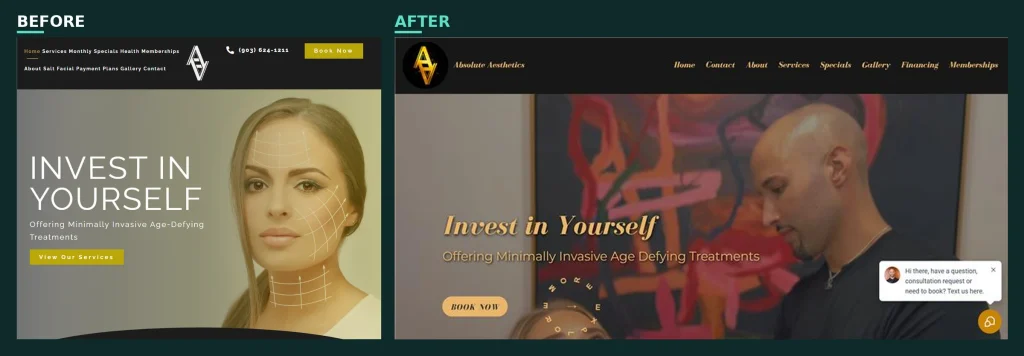
Absolute Aesthetics is a med spa offering minimally invasive, age-defying treatments. Their previous website relied on a stock model photo, a crowded menu, and a generic look that did not reflect their provider-led experience. They came to 4Arcs Consulting for a site that felt premium and made booking simple.
Before-and-after homepage redesign of Absolute Aesthetics by 4Arcs Consulting. Before: a stock model photo, a crowded two-row menu, and a “View Our Services” button. After: a dark charcoal and gold serif design, a hero video of the provider treating a client, a “Book Now” button, and a chat widget.
Our team redesigned the site using the trends in this guide:
Quiet luxury and editorial design: A dark charcoal palette with gold serif typography.
Real provider imagery: A looping hero video of the provider with a client, compressed and delivered through a CDN for fast loading.
Mobile-first booking: A prominent “Book Now” button in the hero and a streamlined booking path.
Clearer navigation: A single-row menu with easy-to-find Financing and Memberships pages.
Easier to connect: A chat widget that answers questions, takes consultation requests, and helps visitors book.
AI search readiness: Structured content and schema that help search engines and AI tools understand their services.
Here is what our client said about working with us:
“Sam and the 4 Arcs Consulting team were absolutely amazing! Their professionalism and expertise took my website to an entirely new level. They were excellent communicators, always quick to respond to my questions, and skillfully brought my vision and ideas to life. The result is a beautiful, engaging, and dynamic website that I’m thrilled with!”
★★★★★ 5.0/5.0 Google review from Jason Badgett, owner of Absolute Aesthetics.
The med spa web design trends shaping 2026 share one goal: make it easy for the right client to trust you and book. Quiet luxury sets the tone. Mobile-first booking, transparent pricing, and treatment pages remove friction. Provider-first content, speed, accessibility, and AI-ready structure help the right clients find and choose you.
You do not need every trend at once. Start by testing your booking path on your phone, checking your page speed, and giving each core treatment a clear page. Then layer in design updates that fit your brand.
Ready to Upgrade Your Med Spa Website?
Your website should reflect the quality of your treatments, build trust with prospective clients, and make booking straightforward. 4Arcs Consulting helps med spas, aesthetic clinics, and wellness brands create professional websites designed around user experience, search visibility, and conversions. Let our team help you identify the improvements that matter most for your business.
It balances a premium look with clinical credibility. It loads quickly on mobile, makes booking easy from every page, shows who your providers are, and gives each major treatment its own page.
2. Where should the booking button go on a med spa website?
In the main navigation, above the fold on the homepage, at the end of every treatment page, and as a sticky button on mobile.
3. How is a med spa website different from a day spa website?
A day spa sells relaxation. A med spa also needs to show clinical credibility through provider credentials, clear treatment information, and an organized consultation process.
4. How often should a med spa update its website?
Med spa web design changes quickly, so review your site at least once a year. Update photos, pricing, provider bios, and treatment pages whenever something changes, and plan a fuller redesign when the site no longer reflects your brand or works well on mobile.


What do you think?
[…] comparing agency quotes, read how to measure marketing ROI for a small business so you know which results to ask […]
Comments are closed.