Quick Answer: Choose med spa SEO keywords by what the patient wants to do: learn about a treatment, compare options, or book. Group similar keywords, give each group one page, and track results in Google Search Console. The keyword map below shows how to assign them without creating competing pages.
Key Takeaways
- Sort keywords by patient intent before you look at volume.
- Give each keyword group one page, not one page per phrase.
- Use treatment, concern, cost, comparison, and recovery phrases.
- Check results in Google Search Console, not by guessing.
- 4Arcs Consulting provides SEO services for med spas.
In This Guide
- What Are Med Spa SEO Keywords?
- What Kinds of Med Spa Keywords Are There?
- How Do You Find the Keywords Patients Use?
- How Do You Group Med Spa Keywords?
- Should a Keyword Get Its Own Page or Just a Section?
- How Do You Build a Keyword-to-Page Map?
- How Should a Page Use Its Keyword?
- How Do You Track Whether Keywords Work?
- What Should You Avoid With Med Spa Keywords?
- Conclusion
What Are Med Spa SEO Keywords?
Med spa SEO keywords are the words and phrases patients type into search engines when they look for treatments, answers, or a provider. They range from a question about a treatment to a search for a local provider. People also call them med spa keywords. They guide which pages you build and what each page should answer.
A keyword is only useful when you know what the searcher wants. A patient who types a treatment name wants an explanation, while one who types a treatment plus a town wants a provider.
What Kinds of Med Spa Keywords Are There?
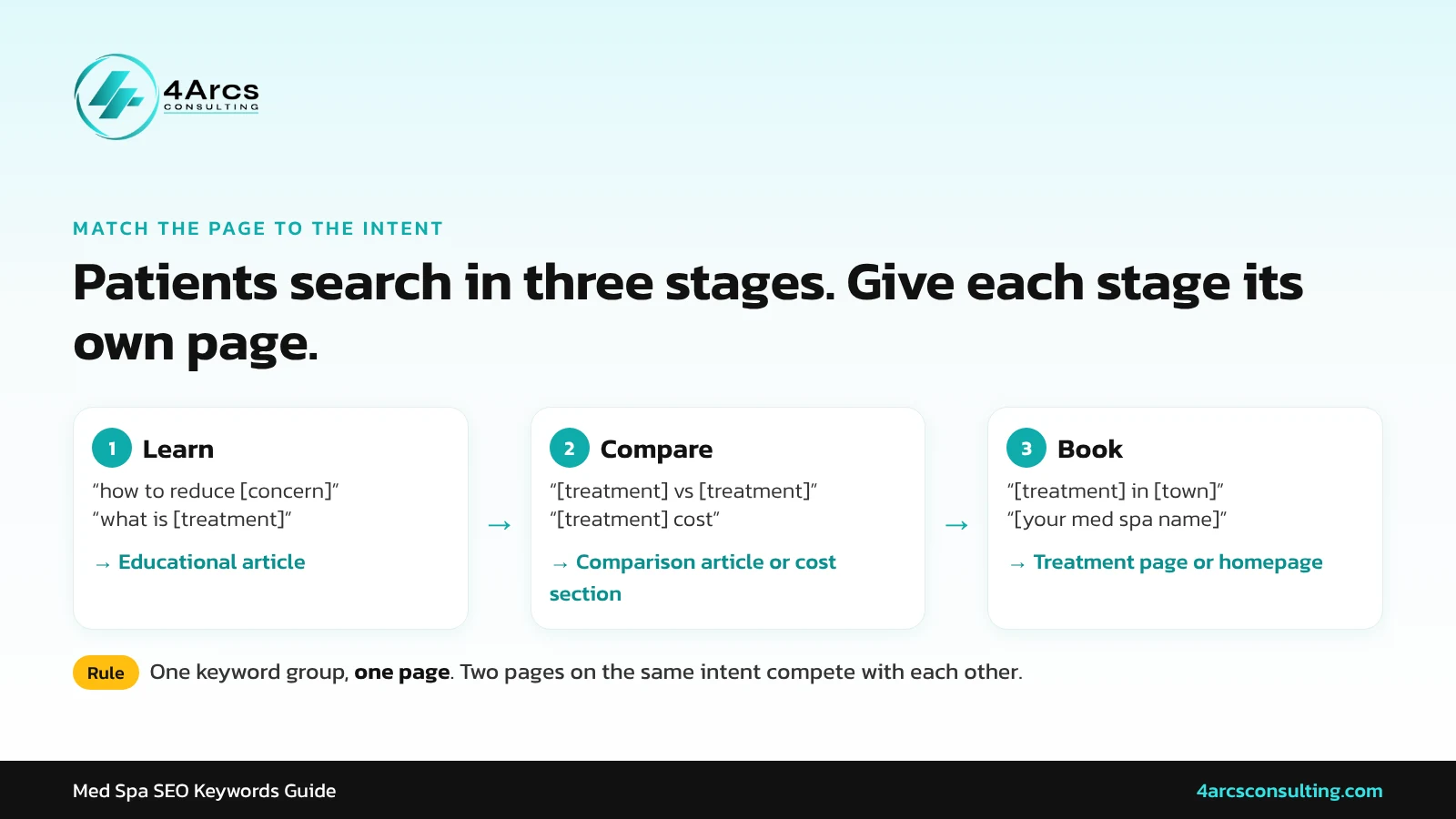
Group keywords by what the searcher wants to do. Treatment, concern, cost, comparison, and recovery phrases each need a different kind of page. The table below uses placeholders in brackets, so you can fill them with your own services and town.
| Keyword type | Example pattern | Best page |
|---|---|---|
| Treatment | [treatment] in [town] | Treatment page |
| Concern | how to reduce [concern] | Educational article |
| Cost | [treatment] cost | Treatment page section or cost guide |
| Comparison | [treatment] vs [treatment] | Comparison article |
| Recovery and safety | [treatment] recovery | Treatment page section |
| Brand | your med spa name | Homepage |
Treatment-plus-town searches often show a map listing above the regular results, so keep your Google Business Profile consistent with your treatment pages. Our med spa Google Business Profile guide covers each field.
How Do You Find the Keywords Patients Use?
Start with what patients already say. Use your service list, search engine autocomplete, your own Search Console data, the questions patients ask at consultations, and the words they use in reviews. Real patient language beats a purchased list, because it shows how people describe their concerns.
- List every service you offer.
- Type each service into a search engine and note the autocomplete suggestions.
- Open the Performance report in Google Search Console and review your queries and pages.
- Write down the questions patients ask at consultations.
- Note the words patients use in reviews and messages.
Google’s Search Console Help explains that the Search results report shows queries, pages, clicks, impressions, and average position. The default view covers the past three months.
How Do You Group Med Spa Keywords?
Group keywords that need the same answer, and give each group one page. Two phrases that a single page could satisfy belong together. Two phrases that need different answers belong on different pages. Intent decides the grouping, not word similarity.
Worked example with real autocomplete phrases (Google, United States, collected November 18, 2026; no volume data). The phrases “med spa keywords” and “medical spa keywords list” both ask what keywords to use, so one educational page can serve both. The phrases “med spa seo company” and “med spa seo agency” ask for a provider, so they need a service page, not an article.
A second cluster shows the same logic: “med spa photo consent form”, “medical spa photo release form”, and “med spa before and after photo consent” all ask for the same thing, so one page should answer all three. Our med spa photo consent guide is that page.
Should a Keyword Get Its Own Page or Just a Section?
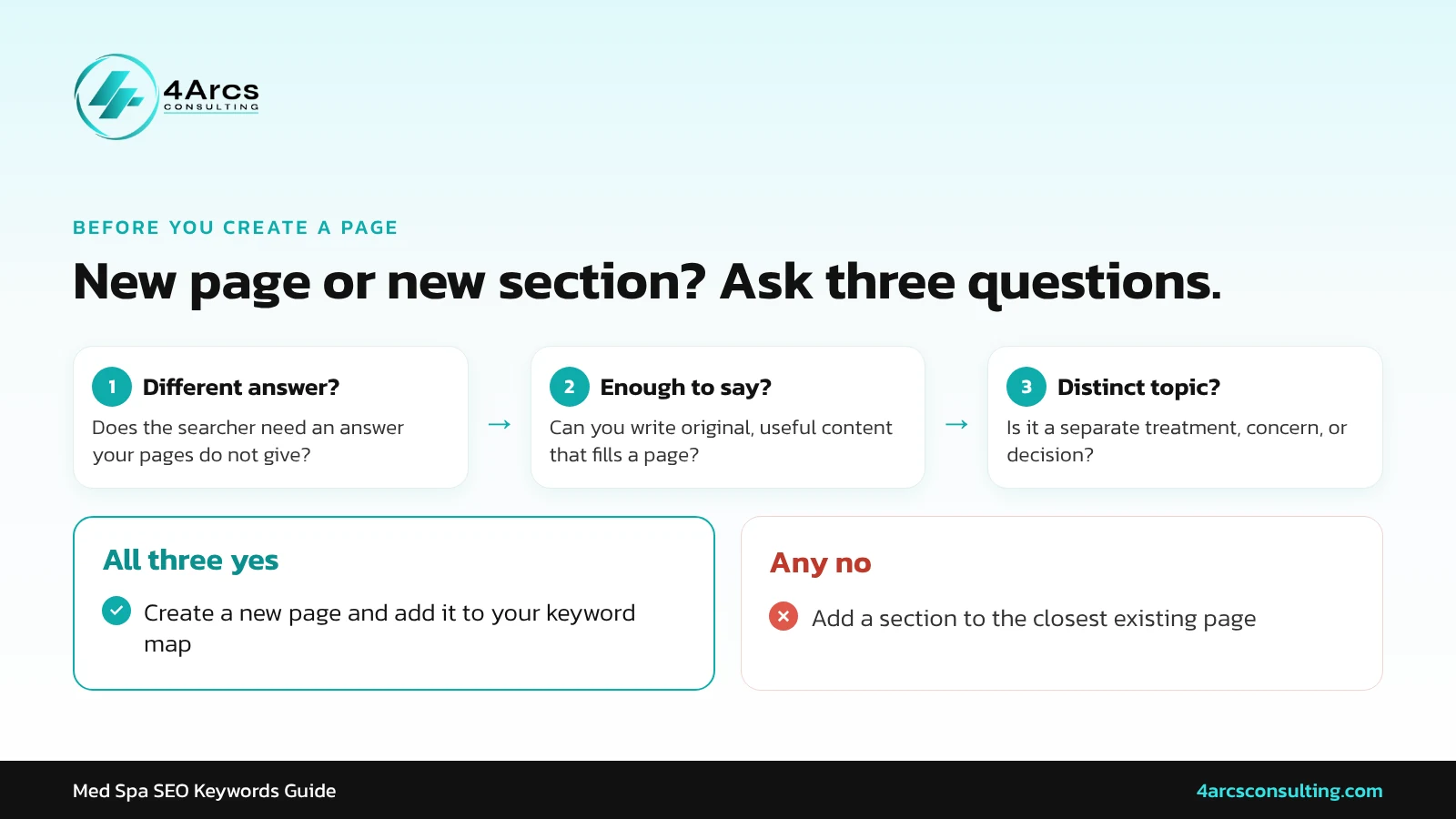
Give a keyword its own page when the searcher needs a different answer than your other pages provide. Use a section when the answer is a short part of a larger page. Ask three questions before you create anything new, and write down the answer each time.
- Does this searcher need a different answer than existing pages give?
- Can you write original, useful content that fills the page?
- Is it a distinct treatment, concern, or decision?
If the answer to all three is yes, create a page. If not, add a section to the closest existing page.
How Do You Build a Keyword-to-Page Map?
A keyword map is a simple spreadsheet that assigns every keyword group to exactly one page. It shows where to write something new, what to improve, and where two pages compete. Update it whenever you add a page. Two example rows are shown below.
| Keyword group | Main keyword | Intent | Page | Status |
|---|---|---|---|---|
| Photo consent | med spa before and after photo consent | Learn | Educational article | Live |
| Provider search | med spa seo agency | Hire a provider | Service page | Existing |
Want help building your map? Our med spa SEO page explains how we approach it.
How Should a Page Use Its Keyword?
Put the main keyword in the title, the first heading, and the opening sentence, then write naturally. Add related phrases only where they fit. Google’s guidance on helpful content says content should primarily help visitors, not attract search traffic, and recommends making authorship and sourcing clear.
Read Google’s guidance on helpful, reliable, people-first content, last updated October 5, 2026. Name products accurately, too. The FDA lists the dermal fillers it has approved, and your pages should match what your providers use.
Targeting works best when each service has its own page. For Mary Philstetler Beauty, we used service-specific targeting and on-page optimization, and the med spa reached a #1 Google ranking and saw 165% growth in organic traffic. Results vary by med spa.
Clients notice the difference too. A med spa owner wrote on our Google Business Profile that our team succeeded where others had not:
★★★★★
“…executing marketing strategies through SEO and helping my business to gain more clients…”
La-Keisha Milord, Google review of 4Arcs Consulting
How Do You Track Whether Keywords Work?
Track what happens after the search, not only where a page ranks. Watch impressions, clicks, and average position in Search Console, then compare them with consultation requests and calls. A page can rank well and still bring no patients if the content or booking path is weak.
| Metric | Where to find it | What to do with it |
|---|---|---|
| Impressions and clicks | Search Console | Spot pages that appear but are not clicked |
| Average position | Search Console | Find pages stuck on page two |
| Consultation requests | Your forms and calls | Judge real value |
| Patient source question | Intake form | Confirm what patients say |
What Should You Avoid With Med Spa Keywords?
Avoid keyword stuffing, duplicate pages for near-identical phrases, and pages built around a competitor’s name. We also advise against exaggerated claims that exist only to match a search. Patients can tell when a page was written for a search engine, and so can Google.
- Repeating a phrase unnaturally
- Making near-identical pages for each phrase
- Building pages around competitor names
- Making claims you cannot support
If you are comparing SEO providers, our guide to reading a med spa SEO proposal explains what to ask.
Conclusion
Choose keywords by intent, group the ones that need the same answer, and give each group exactly one page. Record the result in a keyword map, write for patients first, and check results in Search Console every quarter. A short, accurate map beats a long list of phrases. Our team can help you build one.
Want a Keyword Review for Your Site?
FAQs
Ans. One main keyword and a few close variations that need the same answer. If a phrase needs a different answer, give it its own page.
Ans. Not to start. Autocomplete, Search Console, and patient questions will give you a strong first map.
Ans. We advise against it. Visitors searching a competitor’s name usually want that competitor.
Ans. They should not. Assign the commercial phrase to the treatment page and the question to the article, then link them.
Ans. Review it quarterly and whenever you add a service or page. Retire phrases that never produce impressions.
Ans. Start with one map and add a location column. Multi-location pages need extra care, so plan them deliberately.