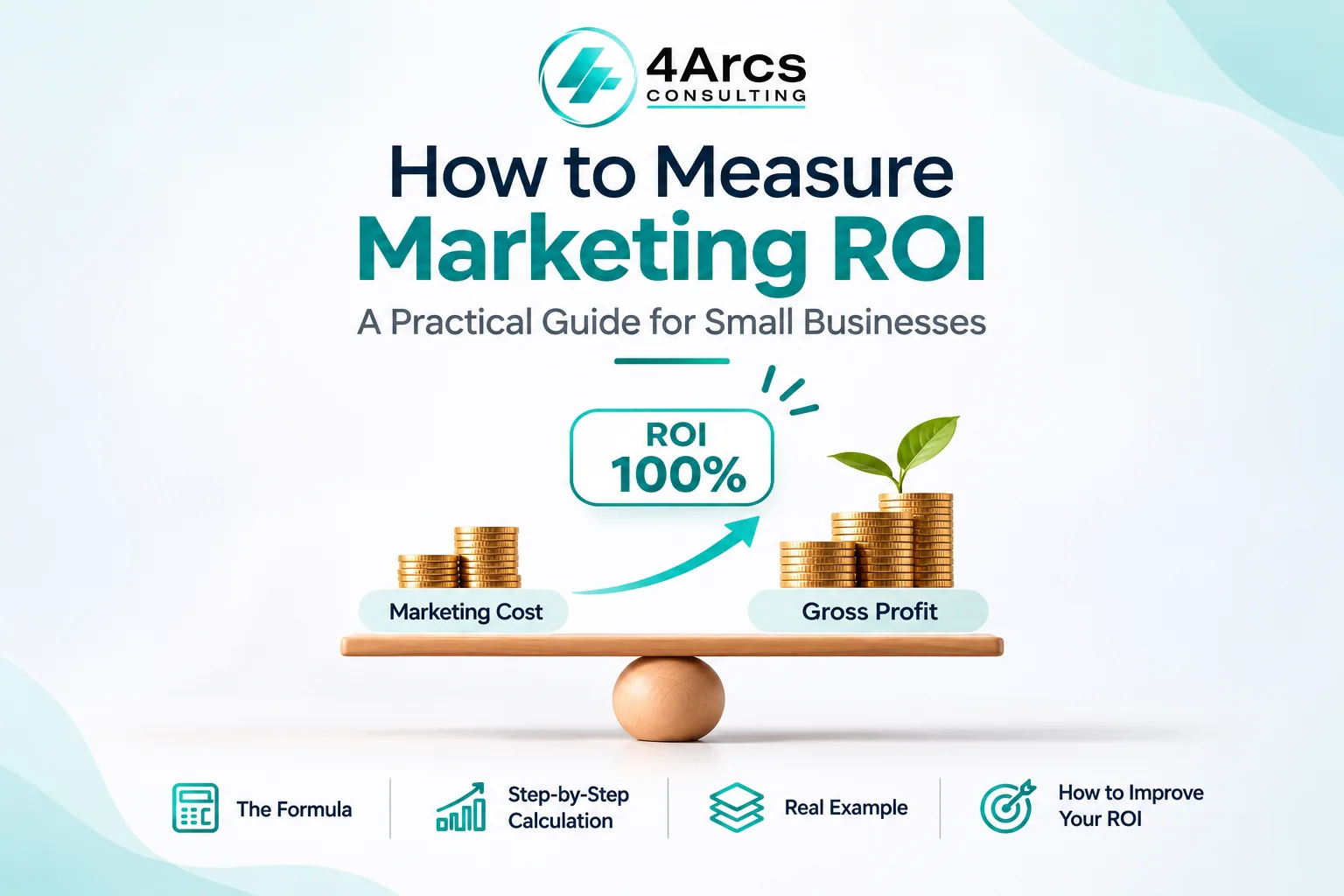
Quick Answer: Marketing ROI equals (gross profit minus marketing cost) divided by marketing cost, multiplied by 100. A campaign that costs $1,000 and produces $2,000 in gross profit returns 100%. Use gross profit instead of revenue, and count every cost, including agency fees, software, and your own time.
Key Takeaways
- ROI = ((Gross Profit − Marketing Cost) ÷ Marketing Cost) × 100.
- Revenue-based ROI overstates results when margins are thin.
- Track cost per lead first, then add customers and profit.
- Judge slow channels such as SEO over months, not weeks.
- 4Arcs Consulting helps small businesses track calls, forms, and direction requests so results are measurable.
In This Guide
- What Is the Marketing ROI Formula?
- What Counts as Marketing Cost?
- What Is the Difference Between ROI, ROAS, CPL, and CAC?
- How Do You Calculate ROI Step by Step?
- Free Marketing ROI Calculator
- How Does Customer Lifetime Value Change the Answer?
- What Does a Multi-Channel Example Look Like?
- What Does a Real Campaign Result Look Like?
- What Mistakes Distort ROI?
- How Do You Set Up Tracking Before You Spend?
- How Do You Handle Attribution?
- What Is a Good Marketing ROI?
- How Long Before You Can Judge a Channel?
- How Can You Raise ROI Without Raising Spend?
- Conclusion
- FAQs
What Is the Marketing ROI Formula?
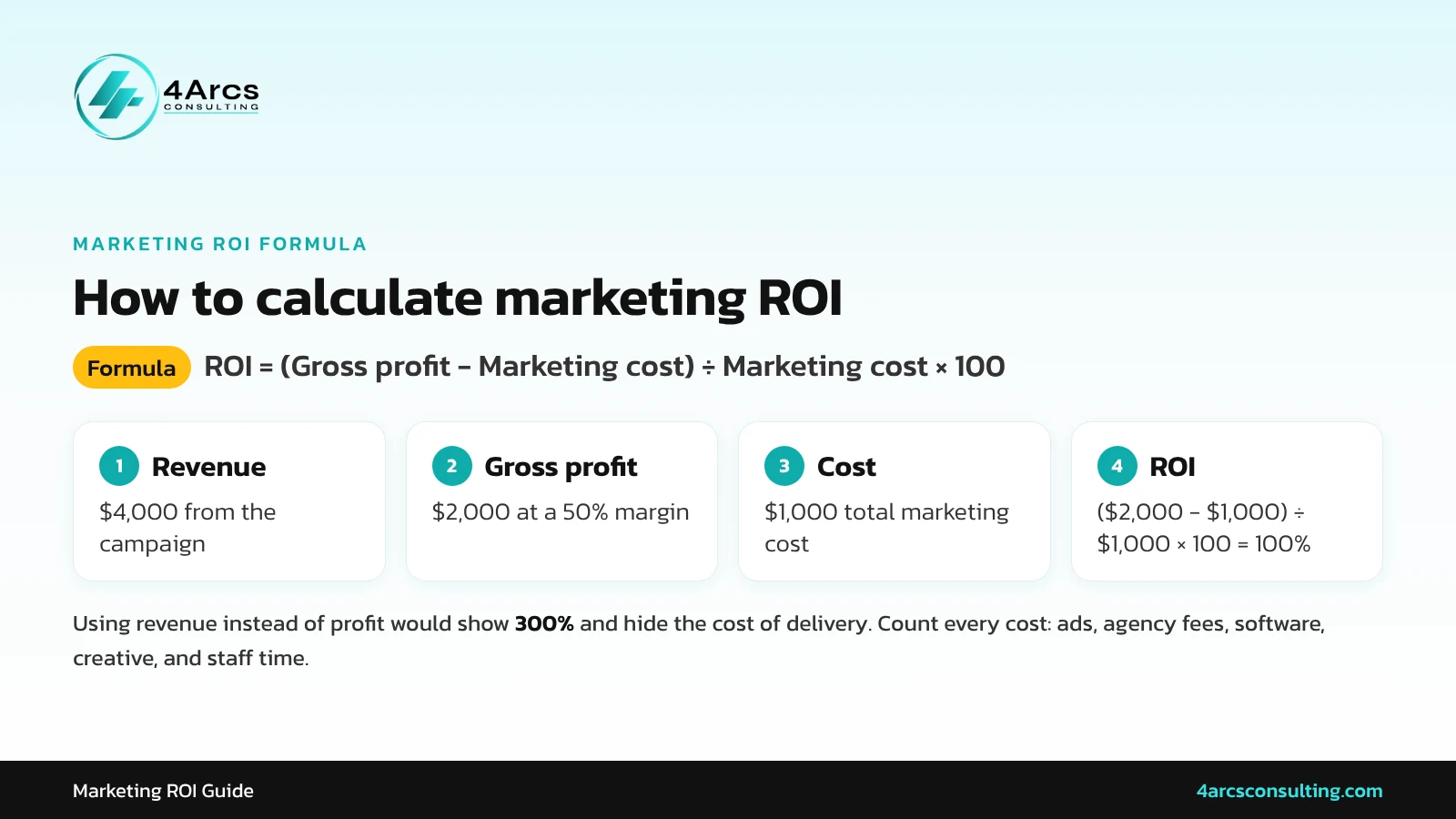
The formula is ((gross profit − marketing cost) ÷ marketing cost) × 100. Gross profit is revenue minus the direct cost of delivering the product or service. Using revenue instead of profit makes campaigns look better than they are, so always start from profit.
| Step | Example |
|---|---|
| Revenue from the campaign | $4,000 |
| Gross profit at a 50% margin | $2,000 |
| Total marketing cost | $1,000 |
| Profit minus cost | $1,000 |
| Divide by cost, multiply by 100 | 100% ROI |
The same campaign looks like a 300% return if you use revenue, which hides the cost of delivery.
What Counts as Marketing Cost?
Marketing cost includes everything you paid or spent time on: ad spend, agency or freelancer fees, software, creative production, and staff time valued at a reasonable rate. Leaving any of these out inflates ROI and hides campaigns that barely break even, so count every line.
- Ad platform spend
- Agency, freelancer, or consultant fees
- Marketing software and subscriptions
- Photography, video, and design
- Staff time spent on marketing
What Is the Difference Between ROI, ROAS, CPL, and CAC?
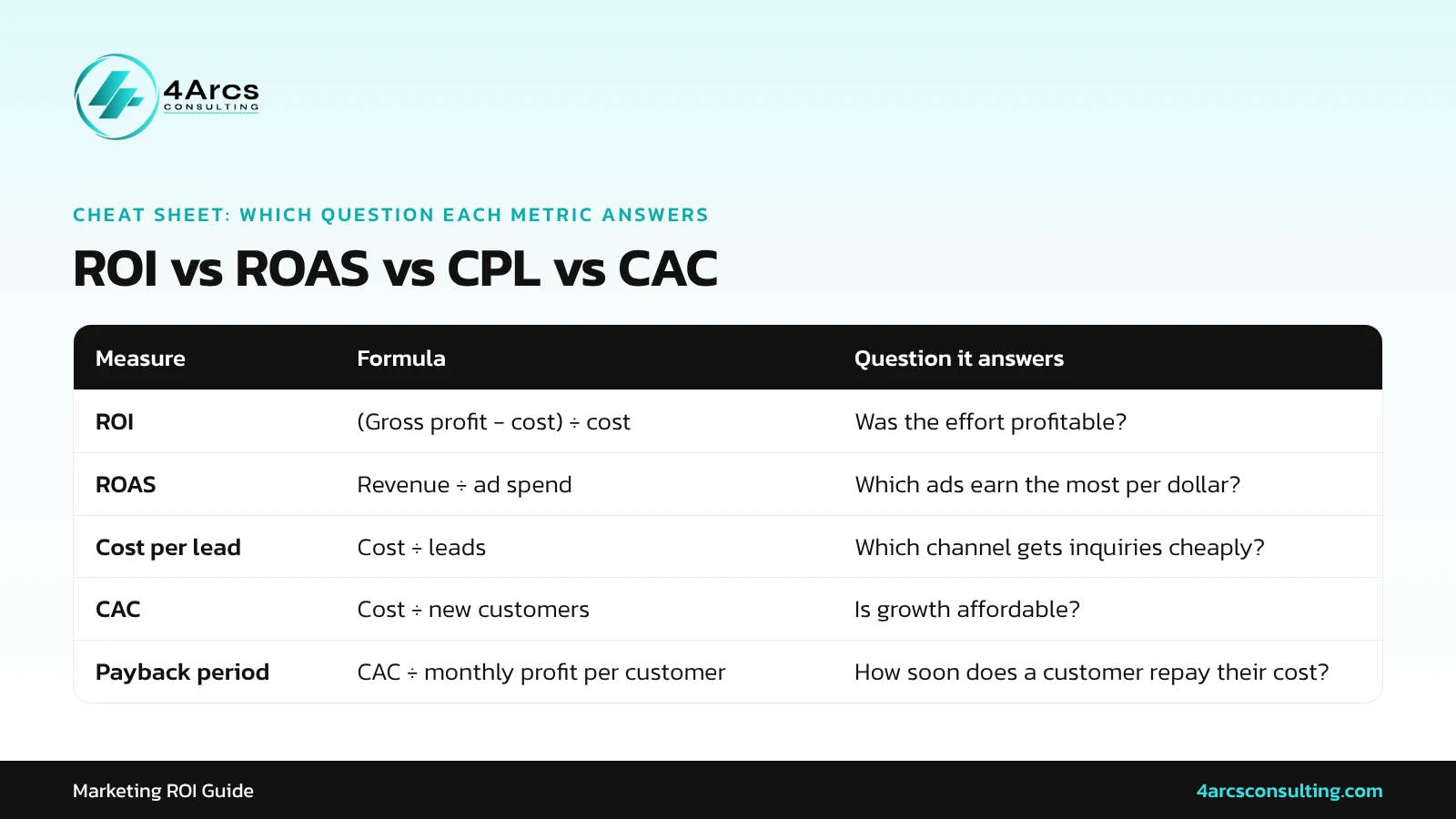
Each metric answers a different question. ROI measures profit against total cost, ROAS compares revenue with ad spend, cost per lead shows how cheaply a channel gets inquiries, and customer acquisition cost shows what a new customer costs. Use cost per lead early and ROI once sales data builds up.
| Measure | Formula | Question it answers |
|---|---|---|
| ROI | (Gross profit − cost) ÷ cost | Was the effort profitable? |
| ROAS | Revenue ÷ ad spend | Which ads earn the most per dollar? |
| Cost per lead | Cost ÷ leads | Which channel gets inquiries cheaply? |
| CAC | Cost ÷ new customers | Is growth affordable? |
| Payback period | CAC ÷ monthly profit per customer | How soon does a customer repay their cost? |
Read these metrics together, not one at a time. A low cost per lead means little if few leads become customers, and a strong ROAS can still lose money once delivery costs are counted, which is why ROI, based on gross profit, gives the final answer.
How Do You Calculate ROI Step by Step?
Work through six steps: total the cost, count the customers, sum their revenue, subtract delivery costs to get gross profit, apply the formula, and compare against your target. Doing it in a spreadsheet each month keeps the numbers honest and makes trends visible.
- Add up every marketing cost for the period.
- Count the new customers the marketing produced.
- Add up the revenue from those customers.
- Subtract delivery costs to get gross profit.
- Apply the formula.
- Compare the result with your target and last period.
Free Marketing ROI Calculator
Use this calculator to apply the formula to your own numbers. Enter the revenue a campaign produced, your gross margin, and your total marketing cost. Add ad spend, leads, and new customers to see ROAS, cost per lead, and customer acquisition cost as well.
Enter one campaign or one month of marketing. Required: revenue, gross margin, and total cost. Optional fields add ROAS, cost per lead, and customer acquisition cost.
ROI = (gross profit − marketing cost) ÷ marketing cost × 100. Results are estimates based on the numbers you enter. Nothing you type is stored or sent anywhere.
How Does Customer Lifetime Value Change the Answer?
A first sale rarely tells the full story. If a customer is worth $900 in gross profit over a year and costs $300 to win, the first purchase may not cover the cost but the year does. Measure value over a time window that fits your business, such as 12 months.
Repeat customers change the math most for businesses with recurring services. A channel that looks weak on first-purchase ROI can be your best source of loyal customers.
What Does a Multi-Channel Example Look Like?
A multi-channel table lets you compare channels fairly. The numbers below are illustrative for a service business with a 50% margin. Search ads look strongest this month, but SEO builds over time and social may feed other channels, so read each result in context.
| Channel | Cost | Leads | Customers | Revenue | Gross profit | ROI |
|---|---|---|---|---|---|---|
| Search ads | $1,500 | 30 | 9 | $6,300 | $3,150 | 110% |
| SEO | $1,500 | 12 | 5 | $3,500 | $1,750 | 17% |
| Social | $800 | 10 | 2 | $1,400 | $700 | −13% |
What Does a Real Campaign Result Look Like?
A real example shows how cost per lead works in practice. Collagen Bar NYC ran paid social campaigns with custom landing pages across its New York locations and reports 900+ leads at about $2 per lead. The case study gives no timeframe or revenue figures, so treat it as a cost-per-lead example, not a complete ROI calculation.
To turn a cost per lead into ROI, you would still need the share of leads that became customers and the gross profit per customer. See the full Collagen Bar NYC story. These are self-reported results and are not guarantees.
Absolute Aesthetics, another client, reports a $4.91 cost per lead from Meta advertising and a 132% increase in qualified leads. Across the two published case studies that report cost per lead, it ranged from about $2 to $4.91. Neither case study includes revenue, so both are cost-per-lead benchmarks, not full ROI figures.

What Mistakes Distort ROI?
The most common distortions are using revenue instead of profit, ignoring staff time, judging slow channels too early, crediting only the last click, and leaving out repeat sales. Each one makes a channel look better or worse than it is, and each leads to a bad budget decision.
| Mistake | Effect |
|---|---|
| Using revenue instead of profit | Overstates returns |
| Ignoring your own time | Hides the true cost |
| Judging SEO after one month | Cuts a channel before it pays |
| Crediting only the last click | Undervalues awareness channels |
| Ignoring repeat sales | Undervalues loyalty |
How Do You Set Up Tracking Before You Spend?
Set tracking up before launch so you can measure from day one. Define what counts as a win, use unique tracking numbers or links per channel, connect ad platforms to conversions, and ask every new customer how they found you. Record cost monthly in one sheet.
- Define a win: a sale, booked call, or form submission.
- Use unique tracking numbers or links per channel.
- Connect ad platforms to conversion tracking.
- Add “How did you hear about us?” to forms and calls.
- Review monthly.
Google explains how to set this up in its guides to conversion measurement in Google Ads and key events in Google Analytics. Key events are the actions you count as wins, such as a form submission or a booked call.
4Arcs Consulting helps small businesses track phone calls, form submissions, and direction requests, so you can see which channels produce leads. At 4Arcs, we report cost per lead, cost per customer, and return on ad spend for paid social campaigns.
How Do You Handle Attribution?
Customers rarely buy after one touch. Someone may see a social post, search your name, read reviews, and then call. No tool captures this perfectly, so compare your analytics with what customers tell you. Where they disagree, treat both as signals, not as truth.
What Is a Good Marketing ROI?
There is no universal benchmark. Margins, sales cycle, and repeat business all change what counts as good, so your own past campaigns are the best benchmark. For market context, the U.S. Small Business Administration’s market research guide explains how to research customers and competitors.
How Long Before You Can Judge a Channel?
Judge each channel over a window that matches how it works. Paid search needs a few weeks of data, email a month or more, social several months, and SEO six months or longer. Early cuts to slow channels often remove the source of later growth; see our search engine optimization service.
| Channel | Evaluation window |
|---|---|
| Paid search | 4 to 8 weeks |
| 1 to 3 months | |
| Social | 3 to 6 months |
| SEO | 6 months or more |
These windows are practical guidelines, not rules. A longer sales cycle needs a longer window. If paid search is part of your mix, see our Google Ads management service. For an example of typical SEO budgets, see our guide to med spa SEO costs in 2026.
How Can You Raise ROI Without Raising Spend?
The cheapest gain is converting more of the traffic you already have, because you have already paid to attract it. Clearer calls to action, faster pages, shorter forms, and stronger proof lift lead volume without extra ad spend. That is the focus of conversion rate optimization.
A strong site also lifts returns; see why every small business needs a high-performing website.
Once you know which channels earn their keep, set your marketing budget around the cost per customer you can afford.
Conclusion
Measure marketing ROI with gross profit, count every cost, and set up tracking before you spend. Start with cost per lead, then add customers, lifetime value, and payback period. Judge each channel over a window that fits how it works. To turn existing traffic into more leads, explore our conversion rate optimization service.
Not Sure Which Marketing Channels Are Paying Off?
FAQs
Ans. Not always. Launch periods and long sales cycles can show a lag before returns appear. Judge the trend over several months.
Ans. Yes, at a reasonable hourly value. It shows the true cost of doing marketing yourself.
Ans. Ask new customers how they found you and compare the answers with your analytics. Together they give a more honest picture than either alone.
Ans. Not at first. A spreadsheet, call tracking numbers, and free analytics are enough to begin.
Ans. Track them separately so you can see what paid and organic channels truly add. It also shows how much of your growth does not depend on advertising.
Ans. Monthly for fast channels and quarterly for slow ones. More frequent checks mostly measure noise.
Ans. A 5:1 ratio, or $5 in revenue for every $1 spent, is a common rule of thumb, not a standard. It is usually measured on revenue rather than profit, so check it against your margins. Your own past campaigns are a better benchmark.
Ans. They usually mean the same thing. ROMI, or return on marketing investment, is another name for marketing ROI. What matters is that everyone calculates it the same way, from gross profit and full marketing cost.
Ans. Not fully. Google Analytics can track key events and revenue from tracked sales, but it does not know your gross margin or costs outside ad platforms. Use it for conversion data, then calculate ROI in a spreadsheet or with the calculator above.